Category Archives: Uncategorized

As An Era Turns – an Opinion Piece

This post is 9 years in the making.  It has to do with family history and family future.

Thanks to certain social issues, we are a few hours away from a new administration. This last election cycle really focused on illegal immigration. The Republican National Convention gave us images of hundreds of participants holding up signs calling for “Mass Deportation Now!”

Despite the fact that immigrant workers generate billions of tax dollars for our economy, $96.7 billion in 2022 to be exact, they are called “takers.” Instead of fining the American employers that hire them, these people are given Tax ID numbers to allow them to work and the government happily takes their taxes. We love the luxury their cheap wages provide for us. They are the underpaid help that wash dishes at our restaurants, clean our hotels, mow our lawns, and harvest our crops.

We’ve allowed these workers to come to the United States for decades, but now we are calling for their mass deportation. They are “dehumanized,” being called animals, snakes, monsters, and savages.  They are 2025’s answer to “The Other.”

I was born in California, and the best part of my upbringing was that I got to grow up with such diverse friends and neighbors. It was wonderful. Racial and ethnic diversity are the norm. When everyone is different, it’s no big deal. That was my experience anyway.

25 years ago I moved to a less diverse state. I didn’t feel it was going to be a big adjustment for me. I’ve never been anything but red, white, and blue. I have never been a part of anything but mainstream culture.

I have a Master’s Degree, a minivan, and a Panera Rewards Card. BUT. There is something about my “ambiguous ethnic blend” that confuses the crap out of everyone here in Oklahoma.

Alas. The way others see you isn’t always the same way you see yourself.

In October 2024, I was watching “Washington Week.” This quote resonated with me. I was in the 33%.
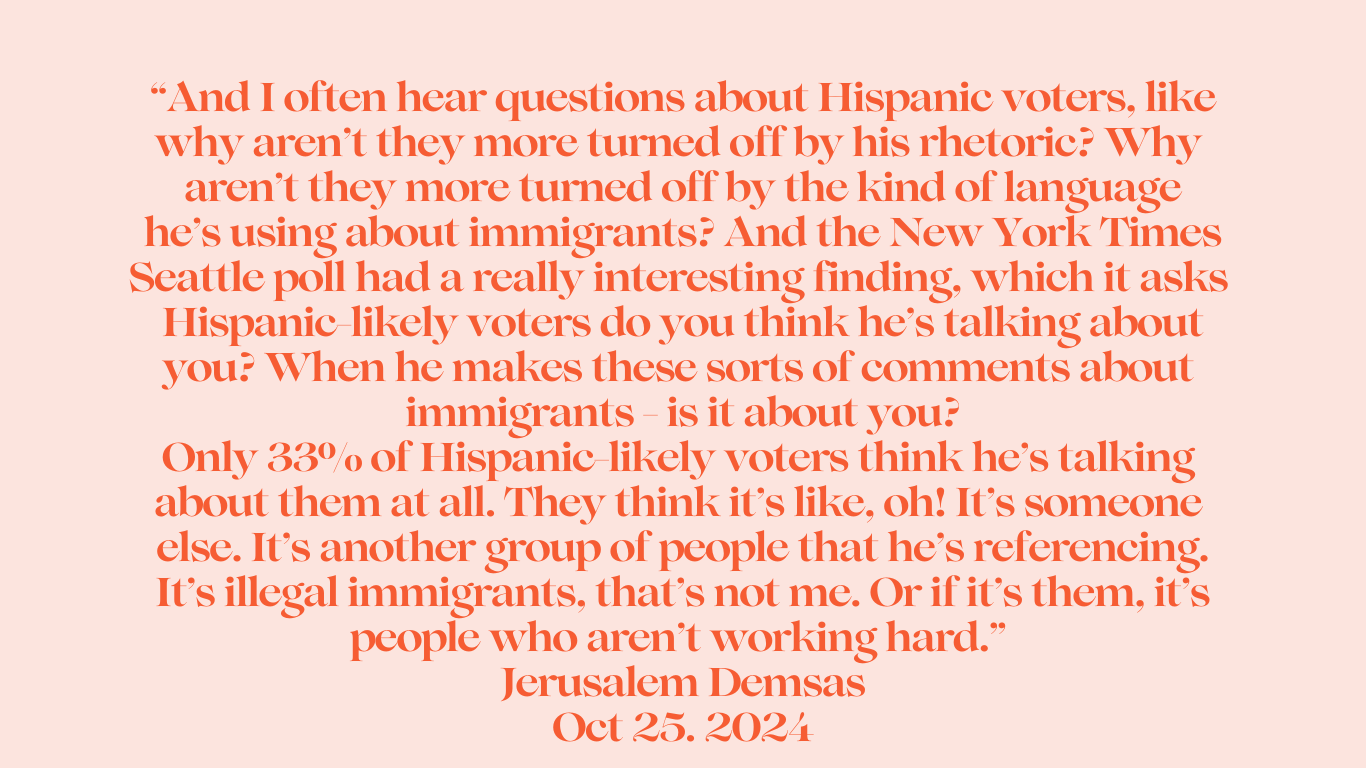
Most Americans feel so far removed from the immigration of our grandparents or great-grandparents we no longer feel like this issue is ours.

Laura Greenlee, a distant Baltierra cousin, was producer of the 1995 movie “Mi Familia.” 13 minutes into the film, one of the characters was caught up in the 1933 deportation sweep of Los Angeles. Maria Sanchez, the mother, was an American citizen. She had no documentation on her and she was sent to a country that was not her own. Was this just fiction?

It was not.

“A Decade of Betrayal” (below) discusses how Mexican families from across the country were deported. One family in the segment was taken from Pocatello, Idaho, in 1931. These children were not allowed to take their birth certificates with them. I mention this story in particular because my uncles Ernie and George were born in Sugar City, Idaho, in 1932 and 1933, respectively. My grandparents were Resident Aliens – given permission to work in the US. All of their children were citizens. How close were the Baltierras from being removed from the country? Was the 82 mile distance enough to save our citizen aunts and uncles from being deported?

My “spider senses” have been tingling since “The Other” spin started taking prominence in 2015 – when Hispanics were called rapists. I started hearing this buzz repeated at the coffee bar at church. I brought up these issues in detail with the pastor of our former church when we met to discuss our departure.

I’ve had so much concern that a few days after the election in November I called a cousin who is an immigration attorney in California. I am certain she thought I was overreacting. I was having a major panic attack that I could be deported! She talked me off the ledge and I am grateful.

Due to personal experiences I’ve had since 2016, I am carrying my passport card. Just in case.

Now I know you’re thinking “girl, you have lost your mind. It’s not like that.”

Here in my little red state politicians are craving national attention, and are diligently parroting a set of party lines to get it. The biggest alarm bell is our Education Superintendent wanting the names of all children who can’t prove citizenship – illegal immigrants. It’s nefarious. It’s appalling.

Not all of my family are as visually ethnic as I am. People who look like me are Americans. But if you don’t know a lot of lovely people like me, you can be confused. I have needed to educate my neighbors about this for 25 years now. For the longest time I could not find the reason I needed to repeatedly share my origin story. Now I think I am supposed to “educate” where I can.

Between my life experiences and my family history research, I realize that many times our family was “The Other,” or “they were the power persecuting ‘The Other.’” Throughout American history, the title has been given to many ethnic groups, but we are going to stay in our lane.

If you are related to me, chances are you have family:

  • who married their daughter to her uncle to keep the family Spanish.
  • sent to an Indian boarding school.
  • listed as “Mulatto Libre” on their baptism records.
  • that took ears from slaughtered Native Americans as proof of a battle won to his superior officers.
  • that were a part of the Slave Trade – as profiteers or as those stolen.
  • accused of serving in the US military in order to earn citizenship, even though that person was American.
  • that were told to stay out of the sun or they would get too dark “like Indians.”
  • that “anglicized” their first name because their given name was too Spanish/too Other.
  • that want the pretense of “spiritual illumination” that comes from their Native American heritage but prefer their middle class lifestyle over life on the Rez and commodity cheese.

Assimilation to a new country is, in and of itself, a good thing. Immigrants are well aware that when they leave their homeland, their family’s culture will most certainly change. And one last surprise. Not all immigrants want to live here permanently. They want to work in the US, send money home, and then leave when they are older.

I guess I am asking my family to think twice about this particular issue. I’m not arguing the legality of the situation. We should be encouraging our law makers to fix this. Just ask my Senator who had his bipartisan bill shot down by his own party to win votes for the 2024 election. Pssst – They don’t really want to fix it!

Just take care not to buy into the dehumanizing verbiage that is being used. Don’t buy into lies about immigrants you know are false – like eating domestic animals. Our families have been there. We know better. We should act better.

Steps of soapbox.

*******

I would like to thank my proofreader Matthew for his assistance on this post.

Very special thanks to Christian Limon.

https://www.politifact.com/factchecks/2016/aug/08/tim-kaine/tim-kaine-falsely-says-trump-said-all-mexicans-are/

itep.org/undocumented-immigrants-taxes-2024/

https://www.npr.org/2024/09/15/nx-s1-5113140/vance-false-claims-haitian-migrants-pets

https://apnews.com/article/congress-border-deal-rejected-lankford-immigration-045fdf42d42b26270ee1f5f73e8bc1b0

https://www.oklahoman.com/story/news/education/2024/12/18/ryan-walters-oklahoma-rules-undocumented-students-osde/77054984007/

https://www.indigenousmexico.org/articles/tracing-one-mixed-race-family-across-the-generations

I encourage you to visit the First Americans Museum in Oklahoma City: https://famok.org

Family. The Long Way ‘Round.

Happy New Year! For this post we are going to discuss distant cousins. One of our great-grandfathers had two grandsons whose paths were very different. One went to Sonora and one ended up in Oklahoma almost 200 years ago. Those events made for an easy one-day genealogy trip to Southeastern Oklahoma.

When I first found out from D. Krebs that I made the Krebs familial cut, he mentioned that there were Krebs’ all over. In fact, there was a town in Oklahoma named after a cousin. When I realized it was Krebs, OK, I was flabbergasted. My husband had been there for work and had eaten an amazing Italian lunch there about 15 years ago. (Yes, our family is food-focused.) I’ve been wanting to visit ever since. But just how this branch of the Krebs family was “our cousins” needs a diagram.

Hugo Ernestus Krebs was my 6th Great-Grandfather. I’ve told you all about him before. The Escalante’s are descended from his first marriage. The OK Krebs come from his second. These two cousins from the Colonial Gulf Coast made life choices that took them in two very different directions.

The week before our excursion, I was planning the itinerary. It started by simply visiting Krebs. The more I dug, however, I realized something. Judge Edmond Krebs was one of many children of Placide Krebs. That meant he had siblings. Researching all of them, I realized Skullyville, Oklahoma, was the place we really wanted to visit.

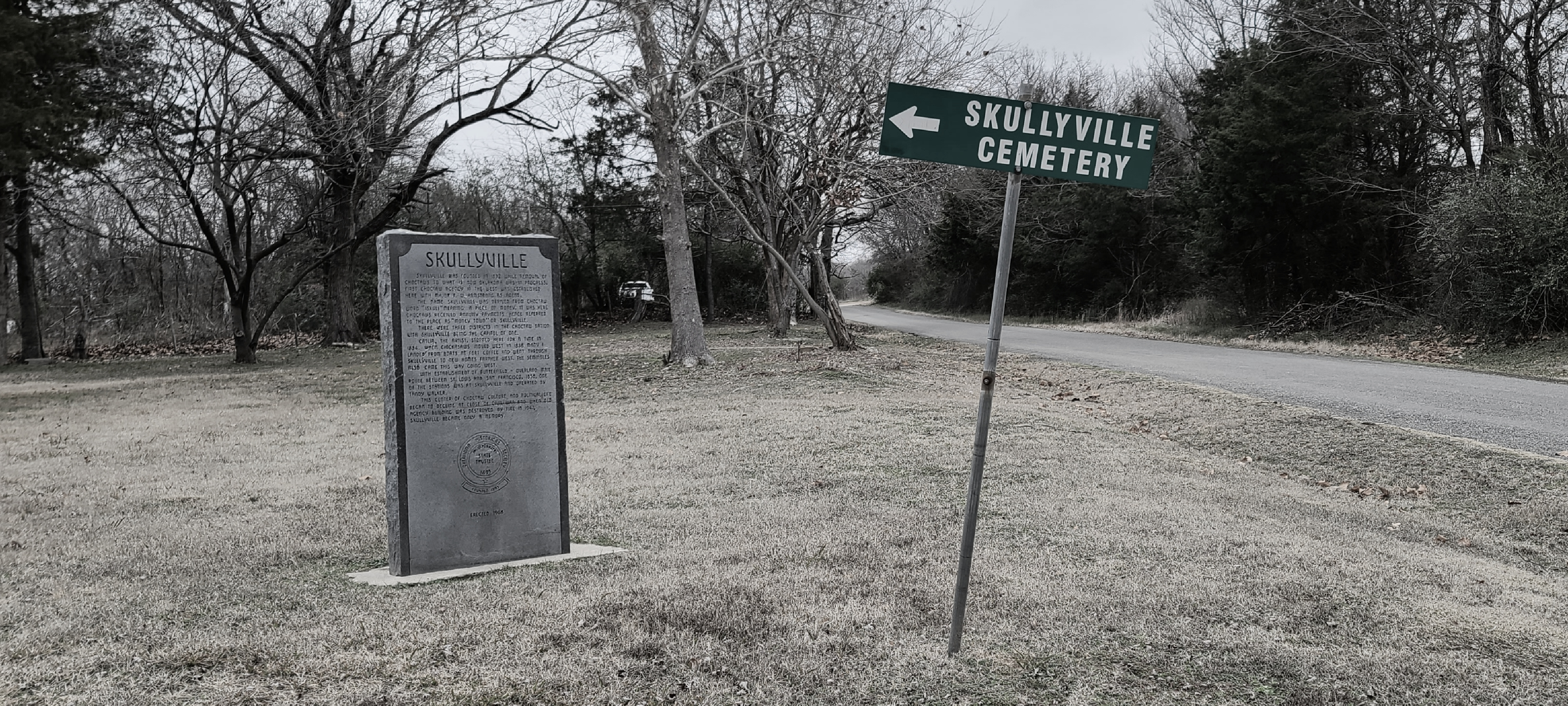
It was a very cold morning in all that’s left of Skullyville.

Placide Krebs married into the Choctaw Nation via his bride Rebecca Folsom. Their family was forced to move from Mississippi to Oklahoma due to the Indian Removal Act/The Treaty of Dancing Rabbit Creek. The Choctaw stopped in this region of the territory in 1832. All that’s left of this town is this memorial and the Skullyville Cemetery. The headquarters to the tribe is now in Durant, OK.

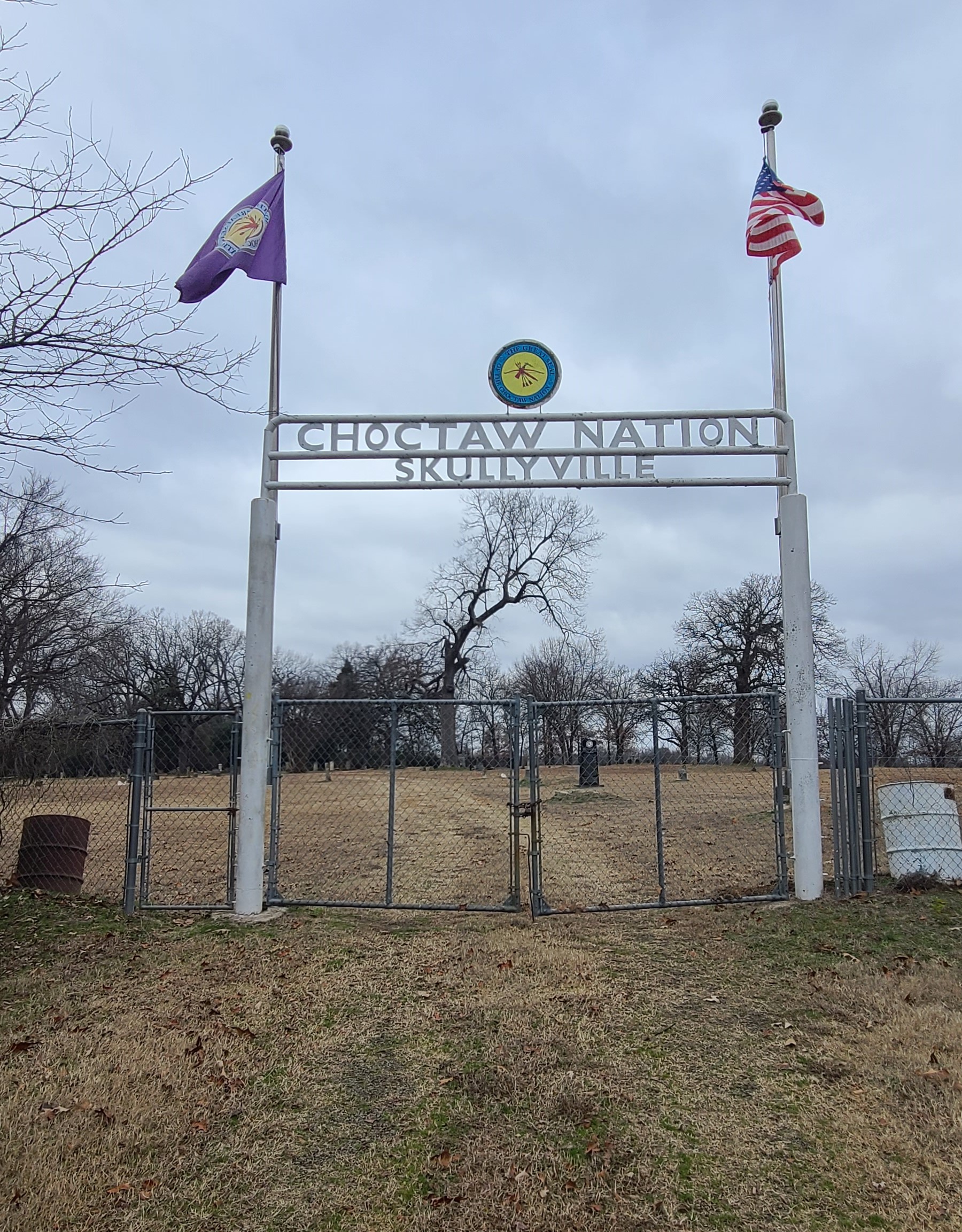
The entrance to this historical cemetery.

We were able to walk around. Many of the graves are unmarked. This place is peaceful as well as haunting. Or maybe it was just the dreary day.

Historical memorial for those who come to learn about the site.

We went in farther. There were several familial groupings. Many of the original Krebs descendants do not have marked graves. Some observations I made: many of the grave markers had Mason symbols on them; several of the Choctaw buried there had served in the Confederate Army. Yes. Escalante’s have cousins who fought in Grey. Just wild.

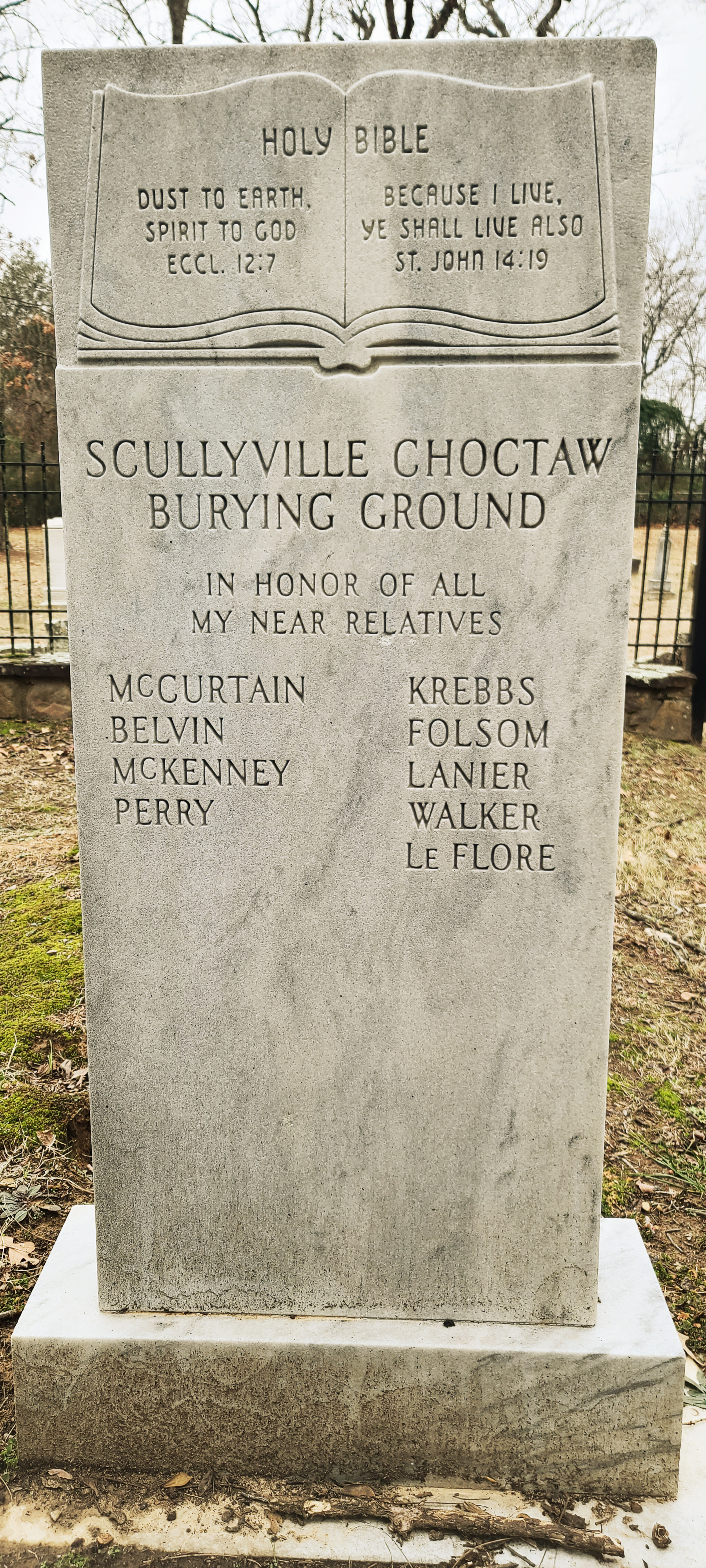
This memorial mentions many of the family names Placide’s children married into. I found a YouTube video of a man who had come to lovingly clean this monument. So grateful for his work. Many of the stones still here are impossible to read.

Judge Edmond Krebs isn’t buried in Skullyville as most of his siblings were. He is believed to have been buried in the North McAlester Cemetery. https://www.findagrave.com/memorial/86168478/edmond-folsom-krebs . We did manage to see the town named after him. We got to the town museum about 10 minutes to closing. Once I name dropped that I was a “distant cousin to the Judge,” they let us stay a few minutes longer. Because of the coal mining in the region, many different immigrants came to the area. A very large Italian community was established here. Krebs’ nickname is “Little Italy.”

The sun finally came out over Krebs.

I was going to do a whole write up about the family history, who married who, etc. BUT! As someone who loves a good internet search, I found a wonderful blog piece from choctawspirit.wordpress.com. Please follow the link and read it!! The research is spot on. There is discussion about the Krebs connection. And lovely photos of those whose roots still live in Southeastern Oklahoma.

One last note. This week, Disney+ released the show “Echo.” It’s about a female superhero who is deaf and Choctaw. The production company worked diligently with the Choctaw Nation for language and cultural accuracies. I’m only through episode 2, but the tribal background/history is fascinating. If you would like to know more about the Choctaw, I encourage you to watch. Support Native storytelling!

Picture it – Northern Sonora, 1775…

During the last few months, I’ve been listening to Borderlandia’s podcast series. Alex La Pierre interviewed the late Dr. Jack S. Williams. Jack was an expert in Spanish Colonial history. He had some wonderful stories. As someone who tries to understand the times our family lived in, this information has been illuminating.

Dr. Williams off-handedly mentioned author Kieran McCarty. I happened to have one of his books in my backpack as my 4th great-grandfather Narbona was mentioned in it. But apparently, there was another book, “Desert Documentary,” that my library didn’t have. I did a quick Interlibrary loan, and voilà, it was in my hot little hands.

Guess what? I found family history in this book as well.

Today’s blog post does something unique. It is going to highlight a female family member. As much as men like to think they create society, there is no population without the women. 8-12 babies aren’t going to birth themselves. In the middle of a desert. But, I digress.

So picture it. Northern Sonora. The VERY Simple Version:

The Locations of Where Our Story Takes Place.

Spanish settlers and peaceful Natives were having issues with Apache aggressions. The Tubac Presidio was supposed to be guarding the San Xavier del Bac mission, but the distance and limited number of soldiers made that difficult. After letters were written and inspections were done, Irish-born-but-Spanish-officer Hugo Oconor declared that Tucson needed its own presidio. August 20, 1775 became the official anniversary of Tucson.

Hugo Oconor doing Spain’s work on the frontier.

Work on the new presidio began. The work was very slow going. That needed to change.

Enter Brigadier Pedro Allande y Saabedra. He was a career military man. He was born in, and devoted to, Spain. He came to the Spanish-Americas in service of his King. He was married to Maria Josepha Tapia. He was part of the Mexican Dragoons (mounted infantry). Pedro was sent to the northern most outpost in the Sonoran territory in 1768. He was made captain of the Tucson presidio on February 19, 1777.

Being a very regimented man, he was appalled at the lack of discipline at the presidio. He worked to get the outpost in order. His methods were rough. Pedro was reprimanded for his “cruel and improper punishment to maintain discipline, and for employing solider and Indian scouts in this private business affairs.”

Ever the disciplined military officer, his troops were some of the most well-trained in the region. Just because they were in the middle of nowhere didn’t mean they were to be a shoddy group. They were known for their shooting abilities. “The commandants harshness got results;” which is why he and his forces were able to stave off an Apache attack of 600 on May 1, 1782. He fought valiantly to keep it safe, getting a severe leg wound that would cause him nerve pain long after. The fighting continued throughout the years.

Tucson remembers Pedro.

Pedro and Josefa had many children together. Most notably, at the time, his “only son” Pedro Maria Allande, who also served in the military. I don’t know the date Josefa died. One book insinuated she had passed before his arrival to Tucson. In a letter below, he referred to 7 of his daughters as “orphan girls.” I am guessing that these young ladies came from his first marriage.

According to the University of Arizona records, Pedro remarried a young woman from an established Spanish-Sonoran family. And that family would be ours.

Pedro married Maria Ygnacia Escalante. She was sister to my 4th Great-Grandfather, Captain Leonardo Escalante. She had been born in 1767 and baptized in Arizpe, Sonora. As a teen-wife, she was at least a generation younger than Pedro, but eligible marriages within acceptable castes were hard to find.

From the University of Arizona.

One of the reasons I’m highlighting this couple is because I was able to find a few things out about them beyond the most basic of information, which is rare for something 250 years ago. Ygnacia and Pedro established a life together in this region of New Spain.

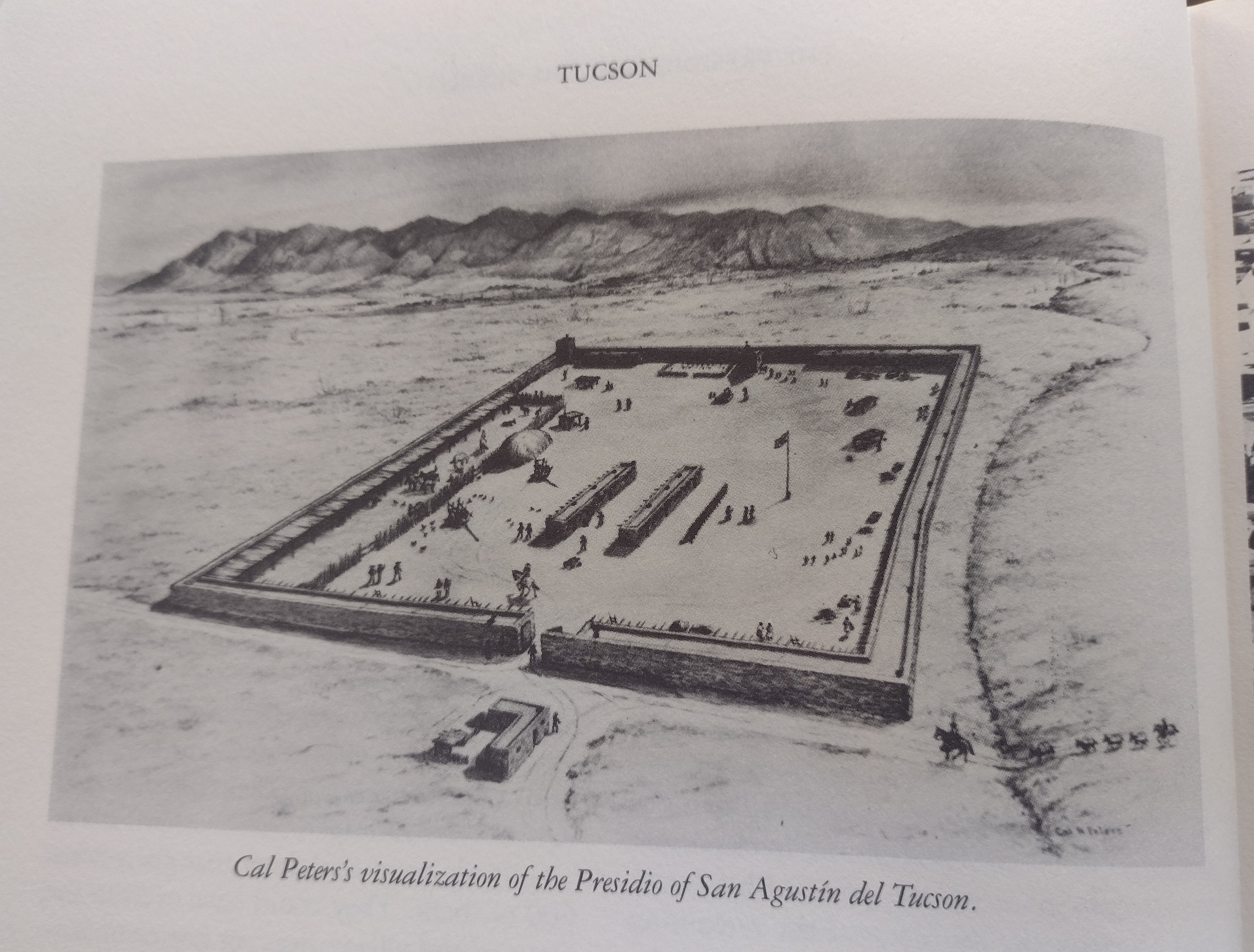
Artist rendition of Presidio – From Sonnichsen’s book.

There is an entire chapter dedicated to Allande’s tenure in Tucson in McCarty’s book. After almost 10 years at this outpost, Allande was ready to retire. His injuries in the many battles he fought against the Apaches were still affecting his physical health. He wrote the King of Spain, desperate for a reassignment. Pedro included his resume of work to illustrate his commitment to his job. Beyond his years on the frontier, he fought the Moors, served in the war against Portugal, and reinforced the Tucson Presidio with no monetary burden to the royal treasury.

Finally, Pedro was pitied and released from duty by Jacobo Ugarte y Loyola, the new commandant general of the northern provinces. The Allande family was sent to Mexico City in 1788 via Horcasitas until he could be reassigned by the King. Ygnacia was very pregnant at the time so their trip necessitated a stop along the way. Pedro’s own words to the Viceroy:

Pedro had a hard time with civilian life. While the family had servants, he didn’t have the military underlings to find him shelter for the group. He wrote that he and Ygnacia had two toddler-aged daughters together already. She was 21 by this time. This was literal family history he wrote! For me!

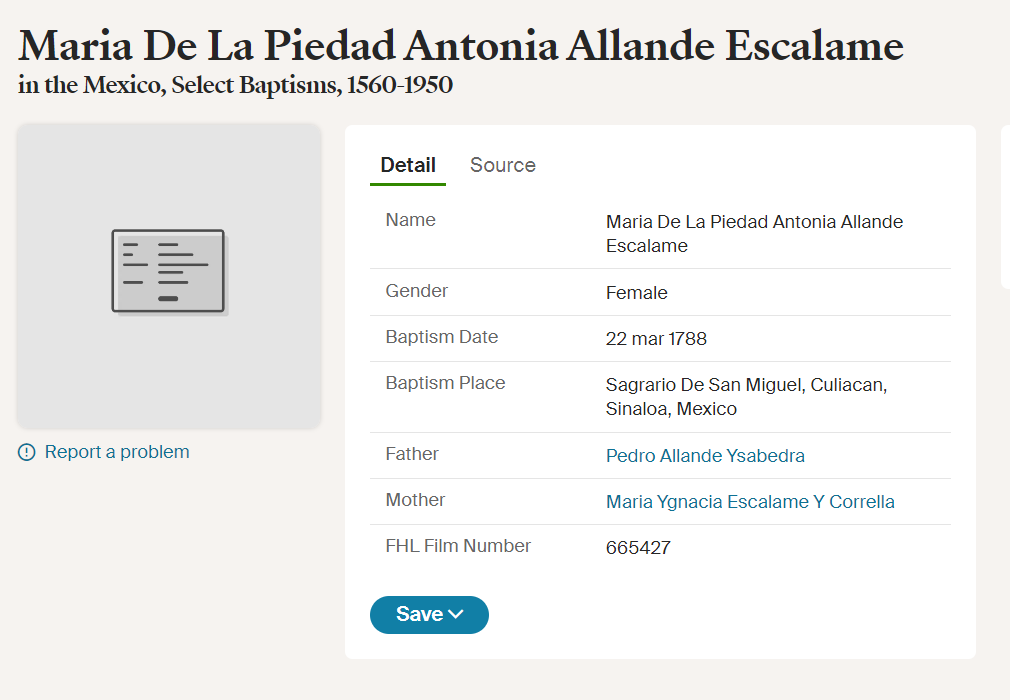
Doing some cross-referencing in Ancestry, I found their daughter. She was baptized in Culiacán where Ygnacia was recovering. Maria was the baby mentioned in the book!

I have known that Ygnacia was married to Pedro for a while now. My research guru Dan King asked me to look into information on a Bishop relation, Father José Antonio Laureano de Zubiría y Escalante. He was the nephew of our Leonardo and Ygnacia. In his paperwork to become a priest, the familial ties needed to be documented. And aren’t we fortunate that they were?! Showing that Ygnacia was married to Allande was a feather in the young man’s cap. The testimonial below documented that these two Escalante’s were siblings to Jose’s mother, Geronima.

This document also shows Leonardo as Captain of the Bacoachi Presidio. But that is another post.

The Allande’s have more children but only one I could find. They had a son in September 1792 while they were living in Mexico City. His name was: Josef Ygnacio Macedonio de la Concepcion Juan Nepomuceno Allande. I’m sharing this because it seems they had put quite a bit of thought into the name, so let’s take the time to appreciate it.

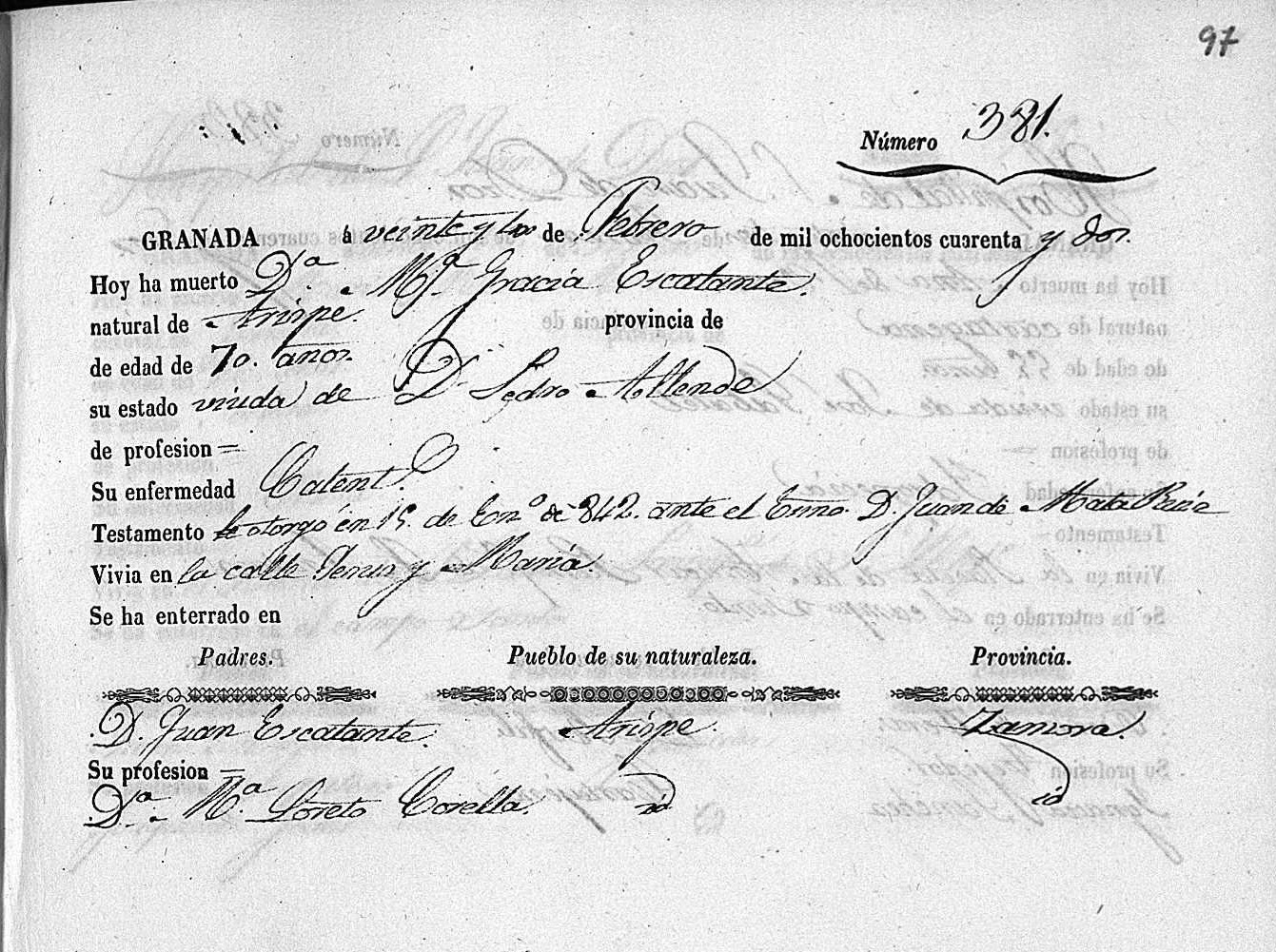
I lost track of the Allande’s after this point. And then I found Ygnacia’s death paperwork. With Pedro’s deep devotion to the mother land, the family went back to Spain. I have to admit that I never thought of any of my relatives born in the colonies would go back to their country of origin.

“Native of Arizpe, Sonora.”

Ygnacia died in 1842, some 5,800 of miles away from her birthplace and birth family. I am hopeful that her life with Pedro was good. He was much older than she was. How long was she widowed without him? Think of all that she saw. From the sparsely populated desert Northwest of Colonial Spain with its wars with Native Americans, to Granada with all of its grand architecture and Mediterranean culture. Was she looked down upon as a “country girl,” kind of backwards? Or was she able to fit in back in Spain?

Maria Ygnacia Escalante was found. From an anonymous mention in a history book, to a wife, mother, and world traveler with a name of her own. We see you, Tia Ygnacia. We see you.

References:

I know I should do official footnotes, but I don’t want to. Haha!

Tucson, the Life and Times of an American City. C.L. Sonnichen. 1982.

Desert Documentary: The Spanish Years, 1767-1821. Keiran McCarty, 1976.

Borderlandia Podcast: https://www.youtube.com/playlist?list=PLFZUxAsw7utPwsWzHs2nZ5cCx2Q2ArVGe

Photo of the Landmark from the Historical Marker Data Base.

Special Thanks:

In September I was able to visit Arizpe, Sonora. It was the most amazing experience that my little genealogical heart could have. I was able to be in the place where Escalantes lived. I went to the cathedral that Ygnacia was baptized in 256 years ago. Thanks to my fellow Borderlandia travelers who gave me some extra time in the Arizpe cemetery.

Thanks to Alex La Pierre and the late Dr. Williams for helping me find Ygnacia’s story.

When it Come to Family History, Trust your Gut.

The post for today is more of a general tutorial lesson in genealogy.

I’ve been doing family history research for over 30 years now. Research was slow going “back in the day.” With so many archives online, genealogy websites too, searching today has never been easier. Historians sharing their trees and what they have discovered for all to utilize is another big advantage.

Or is it?

When I post blog pieces, I don’t do it willy-nilly. I generally have research and sources. I try to attach evidence to show I am not making up the narrative. I have annoyed so many family members. I have found paper trails of uncomfortable truths. And on the flip side, I won’t publish stories of rumored lore that I cannot prove. Luckily, I never said we were descended from Fray Francisco Silvestre Velez de Escalante. That was because I couldn’t prove it. And, we aren’t.

This leads me to Adela Ramirez.

Escalante’s do not know who she is. She sits on a leaf on a far branch of the family tree. She is the adopted daughter of Juan Ramirez. He was the cad who our great-grandmother Mariana Bustamante left her husband Leonardo Escalante for. He also left Mariana with their daughter to marry another woman, but that story is in the archives.

Over on Ancestry, there are many family trees with Adela on them. She is a leaf in many trees. She doesn’t have descendants. As far as I can tell, she married, Jean Baptiste Lambert, lost a baby, and was divorced. Adela kept her married name of Lambert whenever she is listed in later years. She lived with her brother’s family in 1940. Suddenly, Adela disappeared. There were no more leads.

In 2013, someone posted that the Adela Ramirez’s death date below was the one for which we were searching.

Adela appears in the “hint” portion of the “Other Trees” screen.

Find a Grave was helpful in providing a photo of the gravesite at Westminister Memorial Park in Long Beach, CA.

There is even a headstone of said Adela Ramirez!

I had three questions about this. One, if this was actually her, when did Adela decide to give up the name Lambert? Two, who is the beloved sister mentioned on the stone? Any siblings Adela had were already dead. Three, on 4 other sources, in all of these trees, her birth year was 1886, not 1888.

Collectively, these red flags have been bugging me.

For a really long time. Almost 10 years.

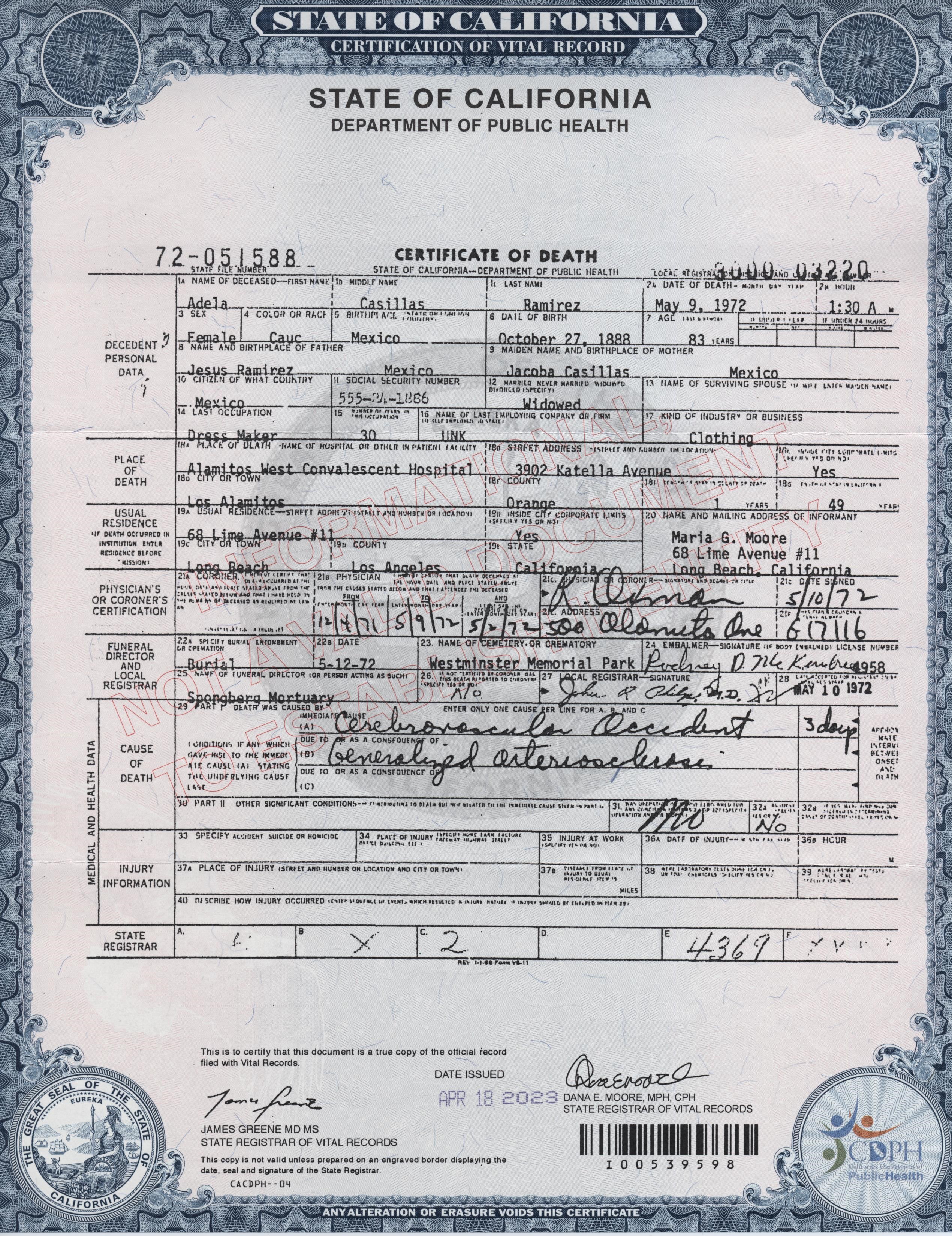
I couldn’t take it anymore. I sent away for this Adela’s death certificate. I feel bad for saying it, but I was hoping the person on these trees was wrong.

I was right.

Another woman named Adela.

The above certificate came in the mail this week. The parents were not Juan Ramirez and Rosa Bustamante as our Adela’s were. This woman was born in Mexico, while ours was born in Los Angeles. This woman was widowed, ours was divorced. A living sister purchased that gravestone. They are not the same person.

I see the simplicity of using the State of California’s Death Index, and a photo of the grave of that person as documentation. It’s nice to find all the information at your fingertips. “It mostly fits together.” On my husband’s tree, I have a group of folks insistent that this woman Esther was their great-great grandmother. That woman lived in Indiana not Ohio. An entirely different state! That is really trying to make it fit. I’ve given up that fight. I just shake my head.

I’m using this example for those of family researchers who have a “gut feeling” about something. You never want to take other people’s research at face value. Note their work. See if you can make the connections they did. Do your own research to get to their same conclusions. If the answers are really clear cut, it should be easy to find.

If you think that something isn’t right, order the paperwork! We are always wanting to find “the source” of information that is key to our moving forward. But also knowing that a source is wrong can be just as important. OR – and I say this with all sincerity – you can even leave the spots on your tree blank if you don’t have a provable answer. It’s better to share accurate information. Eventually you will stumble across the answer or someone else will help out. Patience is a virtue in this hobby.

Do your own research. Trust your own little voice. It’s the best way to learn and to grow as a family historian.

Edward Valenzuela Baltierra

Edward Baltierra, 85, of Stillwater, OK, passed away at his home early on July 20, 2021.

Eddie was born in Atwater, California, on September 13, 1935, to Leon and Pauline (Valenzuela) Baltierra. He was the eleventh of thirteen children. He had been sick for a time as an infant. He always credited his brother Ralph for the blood transfusion that saved his life.

Ed grew up in Firebaugh, CA. He was given a special license to drive at 12 years old because his father was sick and he needed to help his family. He went to Dos Palos High School. He played baseball. When he was 17, one of his best friends, Dinki Allen, convinced him to enlist in the army. His mom had to sign a permission slip to let him go. While Dinki was sent to Germany, Eddie was sent to Korea. Eddie did his basic training at Camp Roberts.

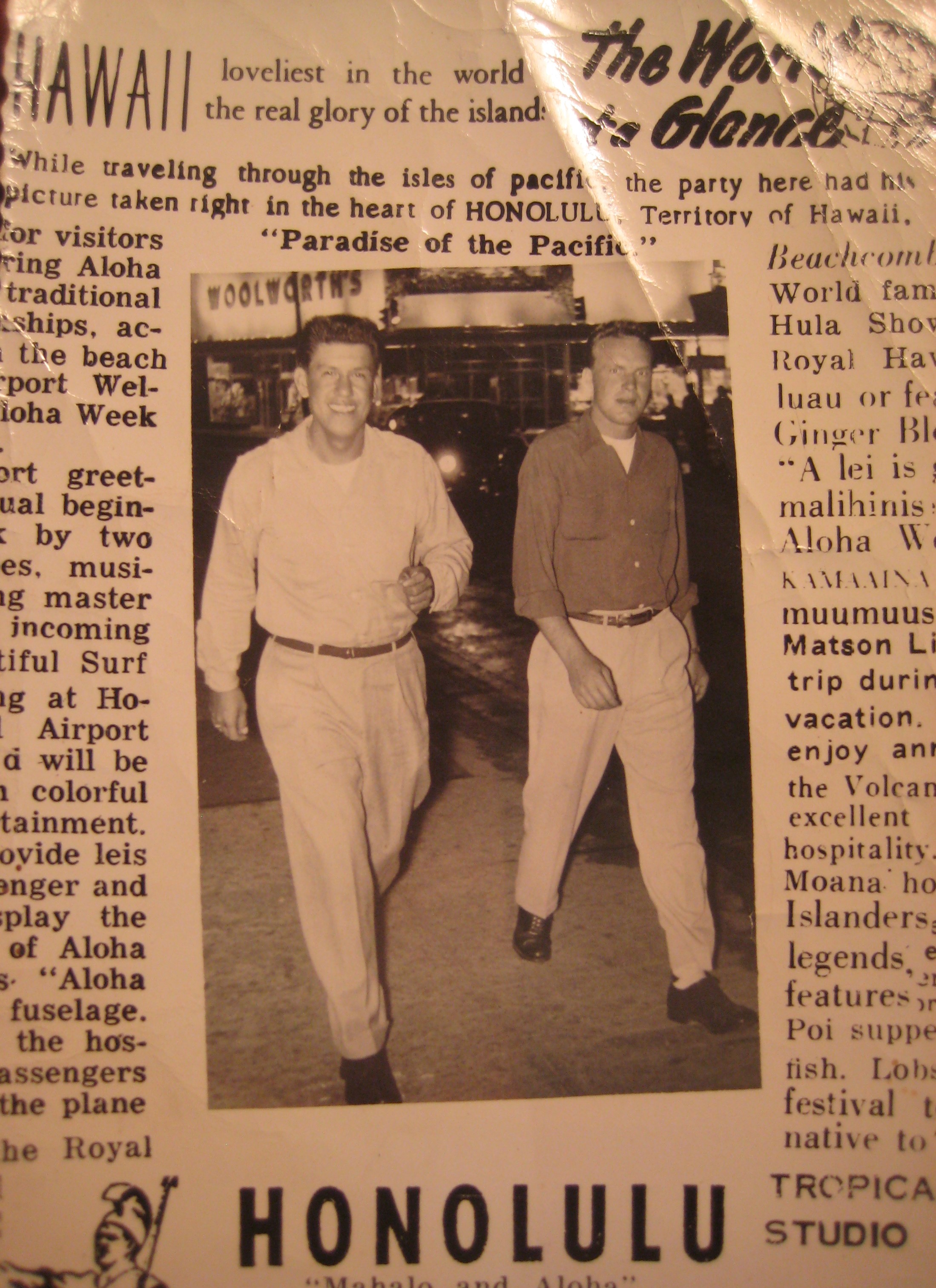
Aloha!

He went to Hawaii and Japan first before Korea. He became a cook. His first time making biscuits, the soldiers threw the hard rocks at the wall to see them explode. When his service ended he had achieved the rank of Staff Sargent. It was one of the greatest times of his life.

Striking a post in chilly Korea.

By the time he came home, his family had moved to San Jose, CA. He was a member of the San Joaquin Club, where he made so many good friends, especially the Plata brothers. He started working at Ford Motor Company’s Milpitas plant where he met great friends such as Arnold Fimbrez, Mr. Boone, Bart, and Sam Varela.

There are no words for how much Ed loved these guys.

They played baseball and partied together. Eddie loved Rock n’ Roll music. Back in the 1950’s, many famous musicians came through San Jose. One of his favorite stories was when he was still in his army uniform. He caught the Platters performing. He asked the lovely Zola Taylor to dance with him, and she did!

Edwina, Edith and Ed on the day of her baptism.

Eddie married Edith Escalante September 4, 1965. They made their home in San Jose, CA. They had one daughter together, Edwina.

Ed carrying Edwina after a long day at the San Francisco Zoo.

Eddie worked 30 years with Ford Motor Company, primarily at the Milpitas plant. He retired from Ford in 1987. Right before retiring he walked through the assembly line in St. Paul, Minnesota, and had his yellow F-150 pick up truck made with the help of his co-workers and friends.

Big Ed and his truck made it into the Arizona Daily Star, 2010.

In 1988, the family moved to Paso Robles, CA. Being a people person, Eddie bartended at the Black Oak Restaurant. He and Edith moved to Tucson in 2001, where he was a shuttle bus driver to the Skyport Airport in Phoenix, and a greeter at Kroger in his later years. He was the proud owner of a beautiful Golden Lab named Abby.

Eddie reluctantly came to live in Stillwater, OK, with Edith in 2017 to be closer to their family in their “Golden Years.” We are ever grateful for the family holidays, birthdays, and Boy Scout events we all got to share these last four years. We managed to keep him safe during the pandemic too.

Ed’s 85th birthday – September, 2020.

He is survived by: his wife of almost 56 years Edith Escalante and his daughter Edwina Kersten; his son-in-law Ted Kersten who was so supportive and caring, helping wherever he could during Ed’s illness- as much as any son would; His pride and joy was his grandson Matthew Edward W. Kersten.

Matthew and his Abuelito during a visit to Tucson.

He is also survived by his sister, Irene Leyva; his sister-in-law Frances Escalante-Fox, whom he loved and would help move whenever she called on him over the decades. Those other very special family members to Ed were his “cuñado” Alex Escalante, special brother’s-in-law Art Escalante and Butch Escalante, Ted’s mom, Betty Kersten, friends Dinki Allen and Elmer Belmont, and all his nieces and nephews who have kept in touch over the years.

Thanksgiving 2020 – Ted, Ed, Edwina, Matthew, Edith and Betty.

Due to Covid, we will be having a small private memorial service. Special thanks to Dinki for helping Ed to have his first Zoom meeting. He loved it. Edith and Edwina would like to thank those family and friends who sent best wishes, calls, messages, and flowers to Ed before the end.

Leonardo and Rufina Got Married

Every once in a blue moon, I find a clue that leads to some really neat information. This last year has been a little dry in the “family history revelation” department. However, yesterday ended up being a great day.

This post has to do with my Great Grandparents, Leonardo Escalante and his wife Rufina Valenzuela. I had a vague notion of when they got married. It was 1887 according to the US Census in 1900. However, that was all the information I could find.

Until now!

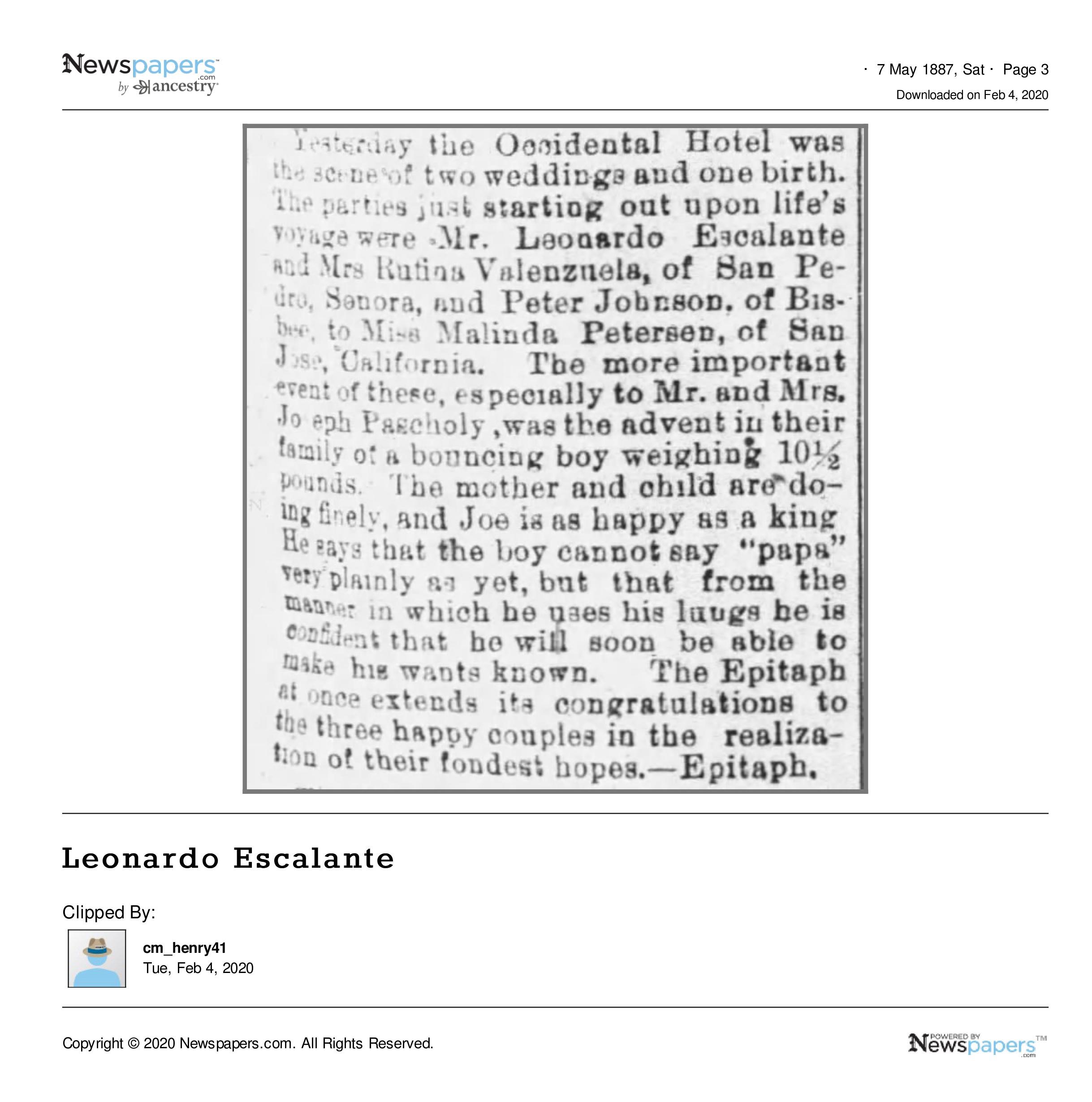
A historian on Ancestry found this snappy little article. Thank you, C. Henry.

It was so neat to see their names together. And getting married. However, the researcher listed that the couple got married in Tucson, AZ. I just didn’t see anywhere where that was documented. I have very serious trust issues on records. Without more information I had to work backward to find sources that would satisfy as “certain proof.”

I went to Tucson’s old newspapers. There was no Epitaph paper there. I am familiar with the “Tombstone Daily Epitaph,” so I wandered that way. While I subscribe the newspapers.com, I could not find this snippet in that paper. Grrrr.

I thought about researching through the backdoor. I looked up the other couple getting married in the article. Peter and Malinda got married in Tombstone that week in 1887. Check one. The Occidental Hotel was in the same town in 1887. Check two. The evidence was getting stronger.

I love to “see” where the life events happened. I searched images for the hotel. While there appear to be no photos, there were several drawings of this really neat hotel in the middle of nowhere. When the postcard below popped up in my search, I may have scared my family with the loud GASP I let out!

This postcard was the clue that clicked everything into place last night. This was where our lovely couple got married the week of May 7, 1887. Do you see the name of the proprietor? He was the man in the Epitaph article whose wife gave birth to their son at the hotel. Check three, baby!

Now how did our loved ones get to Tombstone?

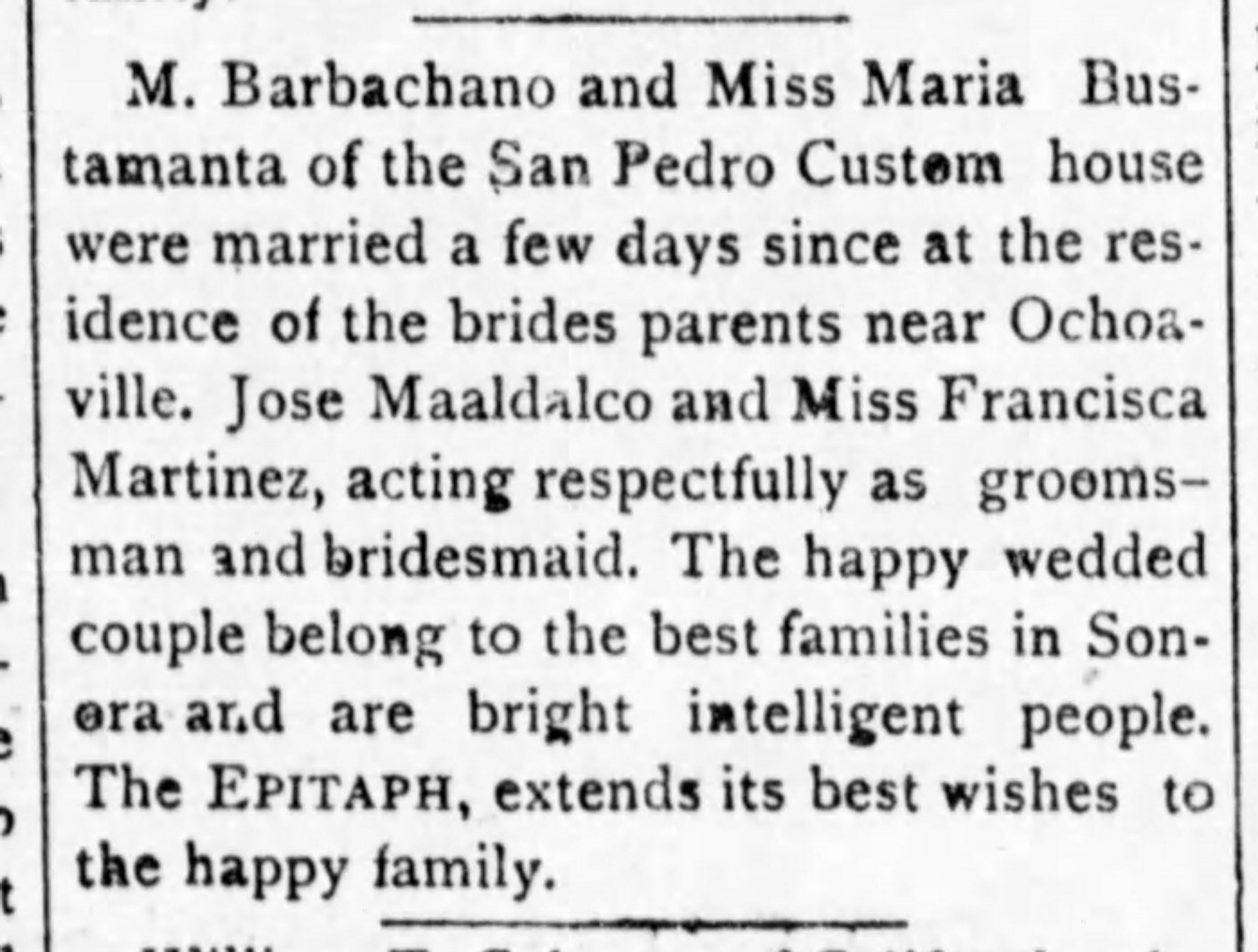
In the month of April, 1887, Leonardo’s half-sister, Maria Ramirez married her beau Manuel Barbachano. In the news announcement of their wedding, it says that her family lived in Ochoaville. (See postcard cancellation above)

Leonardo could have been in the area for his sister’s wedding. His cousins Margarita Escalante de Blackburn and Alejandro Escalante lived in Tombstone and St. David, respectively. Rufina’s father lived in Bisbee. Both groom and bride were listed to be from San Pedro which isn’t too far from the hustle and bustle of this mining district. Nor too far from their new brother-in-law’s work at the Custom House.

In the above map, can you see where the “P” in Pedro is? That is where the tiny town of San Pedro still is. They stayed long enough in the area for their first son, Jose Maria Escalante, to be born there too.

Up until now, I really thought that Leonardo didn’t talk to his sister Maria because their mother left the family to be with Maria’s dad. I know he was a devoted brother to Ana E. de Romo in Ventura and Orange Counties. But this earlier chapter of his life opens so many more theories of their lives together. Ana and Maria become very close after Leonardo died in 1915. There was a good chance that these adults overcame the adversity of their parents drama to become a close knit sibling group. And that is wonderful.

*****

Last, but not least, this blog post is dedicated to all of the friends and family who were touched by COVID this last year. Quite a few of our loved ones recuperated. But not all did. To my Samaniego cousins (via Rufina’s sister Margarita) in Mexicali, Tomas and Diana, rest in peace.

The Farthest Back I Have Ever Been

Howdy do! I hope this post finds you  all safe and healthy in these strange times. Quarantine has been okay for us once we got into the swing of being in such close confines together. I did quite a bit of gardening the first few months. These last few weeks I’ve had some really stupendous progress in the family history department, so I thought I would share with you.

I need to give a quick shout out to my cousin, Jason. He has been my cheerleader and/or Nag-in-Chief with this branch of the family for quite a few months now. He gave me the links that made this post possible. I wasn’t quite “ready” to research so far back into history, especially in an area of the country that is unfamiliar. But when I was it all came together.

The last far back family member I mentioned was Antonio Narbona (1773-1823). He was married to our first familial Escalante – Maria Ysabel. That is WAY back. He had made his life fighting in the Spanish military, which brought him out to the Southwest for Spain, and then Mexico. His link into the military life was his brother-in-law Brigadier General Enrique Grimarest who sponsored Antonio into the military when the kid turned 16.

I’ve not been able to find Antonio’s birth records. Yet. I’m going to need to run down to Mobile, Alabama, when everything opens back up. Road trip!

Researching the Gulf Coast was difficult. This part of North America was not my neighborhood. The time period was so long ago. First, it was Native lands. Then Louisiana/Mississippi was French. And then it was Spanish in 1763. However, it was from where some of our people came.

The names of Antonio Narbona’s parents were originally Antoine Narbonne and Marie Jeanne Krebs. Antoine was born in France in 1745. Marie was born in Pascagoula (now Mississippi) on October 28, 1745.

Do you see how long ago that was?? It was before the United States was born. I almost can’t wrap my brain around it. *Feeling faint, needing a mint julep.*

Antoine and Marie had three children, two daughters and one son. Antoine was killed in 1793. He had been a military man like many around him. I found record of his death in a “Louisiana History” journal article.

Discussion of Capt. Narbona’s murder in 1793.

Marie Jeanne, Antoine’s wife, was from a family long established in the area. Admiral Joseph Simon de La Pointe was a French Canadian who came into the Gulf Coast in 1701. He married Catherine Foucault that same year. He settled permanently in the area, starting a plantation. They had 4 children. Two girls lived to adulthood. One was Marie Josephe  (born in 1720). She married Hugo Ernestus Krebs who had immigrated from Neumagen, Germany, to the area around 1730. We are descended from this couple.

According to various sources, Hugo Krebs was a surgeon and also did well as a plantation owner. He was noted in the book “A Concise Natural History of East and West Florida” by Benrard Romans, written in 1772. Krebs created the first documented cotton gin. It was noted in the above book, predating Eli Whitney’s version by 20 years. (I have included a link to the book at the bottom.)

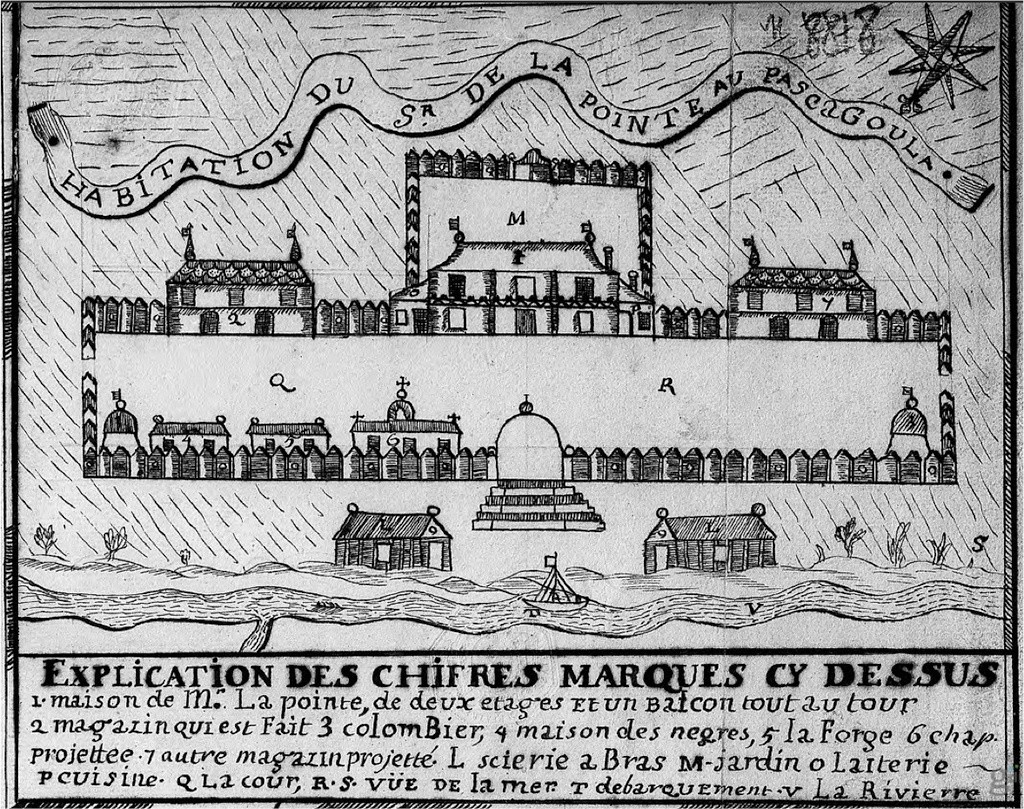
The following map is from the LaPointe/Krebs Museum’s web-page. It shows the original layout of the plantation.

mapofspanishfort

In French, of course.

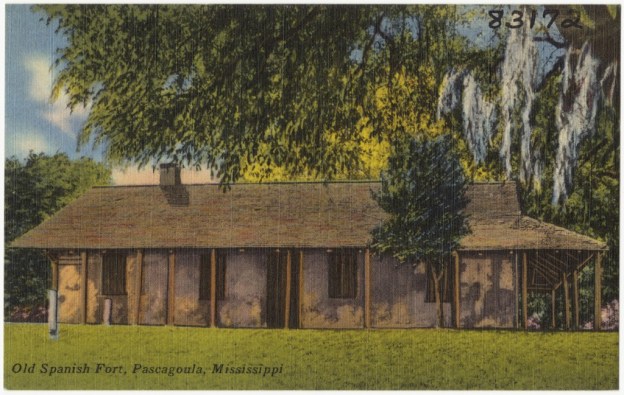
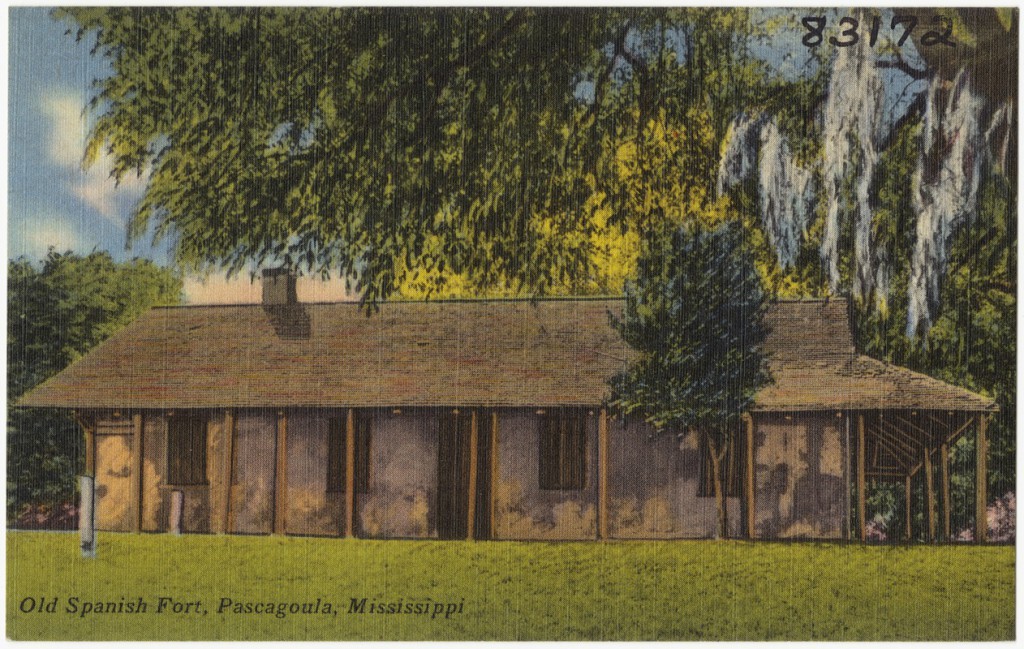
Our branch came from Hugo’s first marriage. Marie Josephe died in 1751. When Hugo died in 1776, the region was now under Spanish control, which is why his will was written in Spanish. He left his daughter Maria Josepha Narbona surpringly out, “having been given nothing.”  Anna Narbona, and her husband, Enrique Grimarest, now the Governor of Mobile, had the house “converted into a fortified residence.”  It is after this when it gained it’s title “The Old Spanish Fort.” It stayed in the Krebs family for generations.

old-spanish-fort-museum-postcard-1024x649

Krebs descendants lived in the house through 1914.

I’m not sure if Anne and Enrique were married a very long time. According to the “Alabama, Surname Files, Expanded” on Ancestry, she died in 1783.

Opera Snapshot_2020-07-29_192329_www.ancestry.com

Brief history of the familial ties to the Narbona Family.

******

Jason sent me many links to assist my search. One of them was a Krebs Family Genealogy site. He had noticed Marie was left out of Hugo’s will. As there is no better way to find out information, I contacted the owner, David. He was so nice! We chatted for 2 hours. I came with my strong evidence of being related to Anna Narbona due to the Grimarest documentation, and the rest is history.

David and I are 6th Cousins, once removed! It boggles the mind.

He shared some great information with me. I have 3 pages of hand-written notes. One story that particularly stuck out to me was this. Some of the Krebs children from Hugo’s second marriage intermarried with the Native Americans in the Gulf Coast area. Their descendants were part of the Trail of Tears and forcibly removed to Oklahoma.

David asked me if I had heard of Krebs, Oklahoma. Yes, I had. Krebs was a mining town. It had a large group of immigrants come to work there. Italians were such an integral group to the area, they still have a yearly Italian Festival. However, Krebs was not a name of Italian origin.

Krebs was named for a famous Choctaw Judge, Edmond F. Krebs (1821-1893), one of Hugo’s descendants. We have distant cousins in Eastern Oklahoma! At the time of his death on Dec. 14, 1893 , the Vinita, IT Indian Chieftain shared, “Judge Krebs died very suddenly at his home in this city Saturday evening of a violent attack of pneumonia. The Judge was a Choctaw Indian and formerly lived near Eufaula. He was quite prominent in that country, being a man of integrity and good sense and have a great many friends in this city also.”

To be called a “man of integrity.” What a legacy.

********

Here is a photo of Hugo.

hugo

Hugo Ernestus Krebs, 1714 – 1776.  Courtesy of D.M. Krebs’ site.

Isn’t this wild? To actually see the face of an ancestor from so far back in history. *gush*

I’m going to put in tons of links at the bottom of all of this if you are interested in learning more. One day, if you visit Pascagoula, you will be able to see the LaPointe/Krebs family home that is still there. It was damaged heavily by Hurricane Katrina, but restoration work is being done.

I do have one more fun thing to share.

MarieJeanneKrebsBaptism

This is Marie Jeanne’s Baptism Record. Courtesy of D.M. Krebs’ website.

I’m one of those weird researchers who Googles every name I come across. I checked the names of Marie Jeanne’s godparents. Marie’s godfather was named as Chevalier Jeann Philippe Grondell. Swanky! Well, he has a Wiki page. (Of course he does.) While he was a young man over here in Louisiana, he was a soldier. He moved up in the ranks in the French army to General. Here is his portrait.

800px-Jean-Philippe_Goujon_de_Grondel

Jean Philippe, back when you had to sit for a selfie. (See source below)*

This has been so fascinating. I honestly thought one day, information on family links would dry up.  This recent search has been a well that has filled my heart with so many different emotions. Beyond our Spanish and Native ancestry, I had no idea that we would find European roots that would be a part of North American history.

As I had difficulty with Antonio’s raid on the Navajo, I am working through my issues about having relatives that were a part of the slave trade and keeping of slaves. However, this branch of the family shows that our cousins have truly been a part of the whole American experience: colonization, immigration, negotiations, oppression, being oppressed, war, expulsion, the justice system, and exploration.

Most of all, each family member showed us he was living life to the fullest, no matter what path that he chose to take.

******


My References and Fun Places to Visit:

Huge thanks to D.M. Krebs! If I got something wrong, please let me know. I’ll fix it.

http://www.krebsfamilygenealogy.org
http://lapointekrebs.org  <-This link is to the LaPointe/Krebs Museum.

https://archive.org/details/concisenaturalhi00roma/page/n7/mode/2up

https://www.mcalesternews.com/opinion/cathey-krebs-namesake-not-of-italian-descent/article_11a0cd3d-ac33-58a1-a390-fe1614eba8cf.html

https://scholarworks.uno.edu/cgi/viewcontent.cgi?article=1181&context=aa_rpts

https://en.wikipedia.org/wiki/Jean_Philippe_Goujon_de_Grondel * {photo credit: By Pderenev – Own work, CC BY-SA 4.0, https://commons.wikimedia.org/w/index.php?curid=46719900}

https://books.google.com/books?id=DLIVAAAAYAAJ&pg=PA59&lpg=PA59&dq=admiral+jospeh+simon+de+la+pointe&source=bl&ots=7blC6rfCVp&sig=ACfU3U3zJGAEozP_7Rc9Km7CO7bv8NmLPw&hl=en&sa=X&ved=2ahUKEwj6z5LT4vjqAhUCX60KHauSAns4ChDoATABegQICxAB#v=onepage&q&f=false (pages 58-59)

“For Defense of Country and the Glory of Arms”: Army Officers in Spanish Louisiana, 1766-1803 Gilbert C. Din. Louisiana History: The Journal of the Louisiana Historical Association Vol. 43, No. 1 (Winter, 2002), pp. 5-40

The “Other” Side of the Family

Today, I’m going to do something very different. I am going to write about the Other Side of my family. GASP! While this site is generally used to tell my mom’s family history, I want you to know, I have a dad too! My cousin John is the family historian over there. BUT. I had a conversation with a 91 year-old aunt of mine and she gave me a clue that led me to go hunting with a very fun find. I had so share with someone!

My dad’s parents were Leon Baltierra and Panfila “Pauline” Valenzuela. They were originally from Durango, Mexico. They left their home around 1914 and came to the United States. Their journey included my Baltierra grandparents, Cecilio and Trinidad. My grandmother Pauline never did see her parents again after leaving home at 13 years old.

I had known the names of my 4 great-grandparents, but had never seen any images of them. I love them dearly, but there was just a large disconnect for me there.

Until very recently.

My aunt Irene lives in Reno. We’ve been chatting more the last few months. She told me a story that another aunt had shared, but this time Irene gave me a HUGE clue that made all the difference in the world.

One day, in the 1930s, my grandmother Pauline and some of her daughters were at the movies in California. It was a Spanish language movie. She saw a character on the screen and stood up, “That’s my father! He’s in the movie!”

Pauline’s parents were Hermenegildo Valenzuela and Paula Perez. Information on them was really limited. And I had looked up Hermenegildo + movies online. Nothing. But when talking with Aunt Irene she casually mentioned that his stage name was Pedro Valenzuela. He had been a cowboy in Durango, got into Mexican movies, and then came to Hollywood to make westerns.

Just like that.

Well, okay then.

Within about a week, I had quite a bit more information than before.

Exactly when he became Pedro I don’t know. But between the time Pauline left home in 1914 to 1920, he left Durango behind and got into movies. He was in the 1920 US Census, room mates with a Steve Matura in Hollywood.

Opera Snapshot_2020-05-18_113818_books.google.com

From the e-book “The Movieland Directory,” page 144

He has several film credits. The first film was “Border Law.” It’s a short Castle Film from 1923. He isn’t the star, but he and his horse come riding in 0:58 seconds into the movie.


Other film credits include: El Robin Hood de Mexico (1928), Las Campanas de Capistrano (1930), Right and Duty (1938).

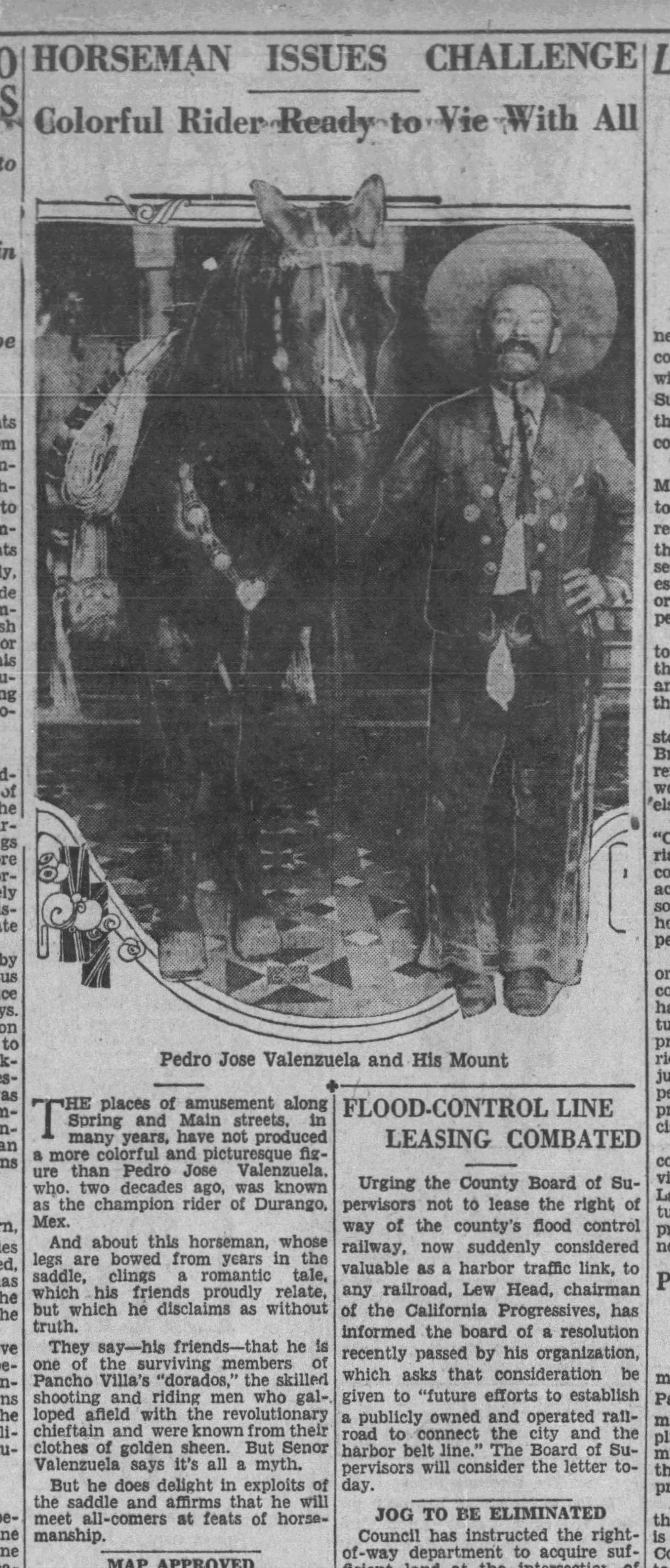
The_Los_Angeles_Times_Mon__Oct_14__1929_

Pedro with his handsome steed, “LA Times”, Oct. 14, 1929.

Pedro managed to get enough press that (once I knew who he was) I could get a better sense of what he was up to in the late 1920’s, early 1930’s. Not bad for an actor who was never the star.

Opera Snapshot_2020-06-08_144514_cinesilentemexicano.files.wordpress.com

“New Movie Magazine,” Jan. 1931.*

You can see the costuming he has above changed from the bedazzled garb of the early 1920’s. And then, the Western/Old West genre started to fade.

Richmond_Times_Dispatch_1933-01-22_10

This article went across the AP wire and was in many newspapers. Jan. 22, 1933.

As the Great Depression kept its grip on the country, American audiences were looking more to comedies and musicals to take their minds off their woes.

You have got to love the internet. His second to last movie was “Let’s Go with Pancho Villa,” (Vámanos con Pancho Villa), 1936. In a time where home videos were non-existent, I can actually watch my maternal great-grandfather on-line. He played a soldier in the movie. The scene I found him in was where the soldiers were celebrating at the bar. You have to love the stereotype of “La Cucaracha” playing in the background, she wrote sarcastically.

You will find Pedro’s character (on left) drinking at a table with his friend who is trying to shoot the light out. The scene is at 55:45 in the film.

And that, my friends, is pretty much all I could find on him.

My Aunt Irene thought he got remarried, but I can find no trace of that. Or that he had more children. My grandmother left home with my grandfather at 13. Pedro must have moved into films immediately following.

I hope that he didn’t find himself terribly impoverished at the end of his days. I also hope he wasn’t terribly lonely. My family was up in the San Joaquin Valley of California by then. He could have gone to visit. He seems to have vanished.

However, I am thrilled to even have at least one photo of one of my great-grandparents.

Thanks for reading! Stay healthy everyone.


*****

I’m going to list some names of the Baltierra/Valenzuela family here so that if someone Googles them, they might find this post. On Ancestry, I have tons of relations I could chat with on the Baltierra side, but my Valenzuela side is lacking. If you find this page because you have searched for the following people, please feel free to contact me!

Cecilio Baltierra (Durango) and Trinidad Rodriguez (Mexicali)

Hermenegildo (Pedro) Valenzuela and Paula Perez (both of Durango)

And for the record, my dad’s Valenzuela is NOT related to my mom’s Valenzuela side. (We have the DNA results to prove it! Haha!)

* The above photo of Pedro and the Newsie was from this great blogsite: https://cinesilentemexicano.wordpress.com/2013/08/20/pedro-valenzuela-en-new-movie-magazine-de-enero-de-1931/


Got Anything for Me, Folks?

Howdy all!

Spring has arrived and is very wet this year. After 17.5″ of rain in the month of May, we are (hopefully) drying out. We have been fortunate enough to have dramatic storms overhead, while the tornadoes have gone around us. Our season isn’t over though…

The last few months have been extremely busy. We had a family reunion in Texas. The boy was finishing school when we turned right around to the Odyssey of the Mind World Final’s at Michigan State University. (If you can find an OofM team for your kid, I cannot recommend it enough!)

We are now in a summer lull. I had an email from a nagging cousin insinuating that I wasn’t blogging recently. I told him I had found all and that there was nothing left to find. He did not believe me! How rude! 🙂

There is an endorphin-rush when clues come together, articles are discovered, and photos are shared by friends of the family. (A huge shout out the Landa family for finding us last week!) But in the cut-throat world of genealogy there are also “dry spells.” It breaks my heart, but it happens. And I am currently in a desert.

Honestly, I am at a point where I have validated all of my theories. Not all are published now. They will be eventually. I’m not in a rush. However, I am at an end of my list of “leads.” After 6 years of having this site I’ve found Tony’s first wife, chatted with her granddaughter, visited her grave. I discovered Tony was part of an international incident while kidnapping his sister’s assailant. I’ve gone through the Magic Photo/Letter Box to find the name of David Perez’s dad. Most of my “need to find” list is done.

I have been given one task. That is to find Elisario Higuera’s information before Yuma. His descendants are vast, but any info on his past and parents are sketchy. Elisario was a mover and a shaker. He was a successful business man, got a 40-acre land grant from the US Government, and put his name on the Native American Rolls right before his death. Quite the Jack of All Trades. He was elusive; a ninja. I will do my best. I also have to wait until more data on him is available.

I do need to hold a bake sale for Tio Jose in Brawley. I got an email that he had no headstone to photograph for findgrave.com. I think he was buried in the “potter’s field” section of his cemetery. Sigh….

I digress. This is where you come in.

Got anything for me to look up? Any rumors you want to confirm? Deny? It may take a while, but I can see what I can do.

Please feel free to send me ideas. If they are super-sensitive, I can send you the results privately. If the story is super cool, and you think everyone would like to know what happened, consider letting me share the narrative here.

Thanks for listening. Off to watch The People’s Court…unless y’all send me something. Bye!

genealogists_humor


Reason #38 Finding Family is Helpful – Our Health

Hi there! How are y’all doing? I’m great. Summer is here. Our tornado season has been mild this year (knocking on wood as I write). My little vegetable garden is rolling along. This isn’t a family history reporting piece. It’s more of a “fringe benefits of doing genealogy” opinion piece.

I kid you not. I have started this piece 3 times, staring in early April. It began differently each time. I have this incredibly morbid obsession about my own death. As I quickly approach my 50th birthday, I’m freaking out about quality of life into my elder years now too. Keeping this piece light-hearted is gonna be a task!

When I visit the doctor I have to fill out those forms that ask for family medical history. I am grateful for all of the boxes I get to skip over, but I always checked off what I knew: Diabetes, Colon Cancer, High Blood Pressure, High cholesterol, Asthma. My 40th birthday was lots of fun. That’s when it was suggested I start all of the testing that goes with creating a “baseline” for the Golden Years. Hahahaha!

Over the last six months, there has been a nagging voice to look at all the Death Certificates I have for genetic direct-line family members.

img331 (2)

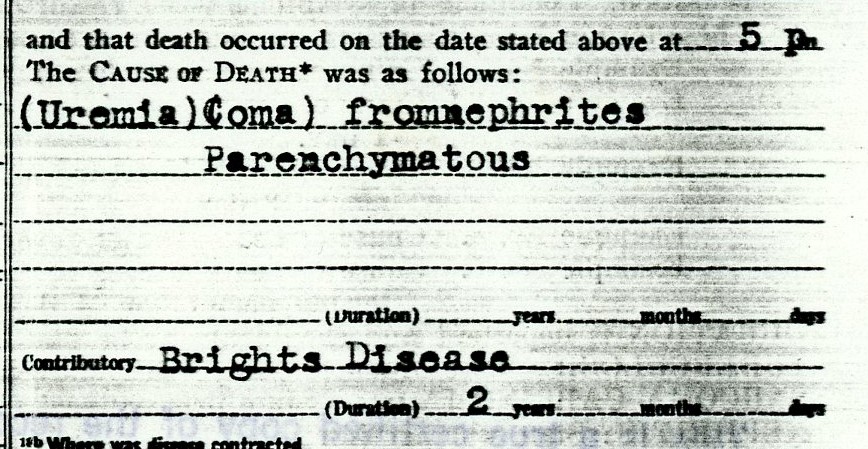
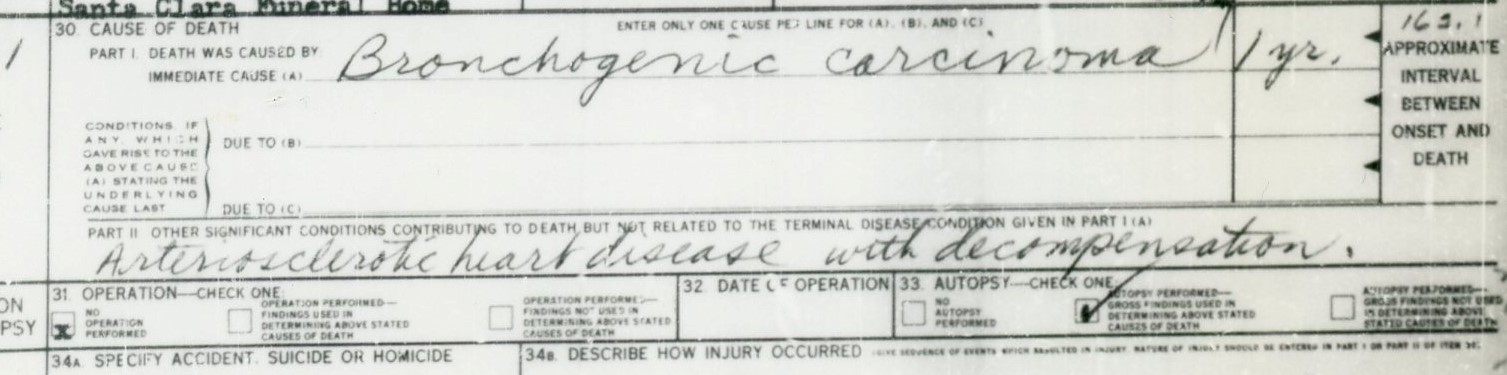
Death certificates can tell you the diseases that your family passed from, as well as how long they endured their condition.

So here are what 6 family members passed from:

  • Lung Cancer
  • Heart Attack (myocardial infarction)
  • Tuberculosis
  • Uremia Nephritis (Renal failure)
  • Colon Cancer
  • Cardiomyopathy (1st cause) exacerbated by Intraluminal Thrombi (2nd cause) exacerbated by Gastric Tumor.

Well, okay then.

About 5 years ago, I talked to my Nina, Phyllis Baltierra. I knew she was unwell, but did not know her specific issues. I asked if she was diabetic. “Oh yeah, honey,” she said. “We all are. You will be too.” What? But I didn’t want to be a diabetic. Needless to say, this conversation was key to my losing weight, exercising, and limiting sugar intake. It started my proactive attempt to take care of myself.

I married into a medical family. For 23 years, I’ve been privy to extensive conversations about dentistry, physiology, biology, medical journals, medical history, and current health issues. My mother-in-law is still so well read she can tell you about new medicines with a mental list of the pros and cons of each.

If I stop and think about it, we can document lots of causes of death on that side of my husband’s family as well. Prostate cancer, heart issues, tuberculosis, asthma, diabetes.

My husband and I actively listen to the friends around us when they discuss health concerns they are currently facing. We are working to face our health future head on. I finished working as a substitute preschool teacher this year because getting up off the floor with a 20 pound child in my arms was getting REALLY hard. I was exhausted when I got home. The job flexibility was great but at the end of the day I had to consider my physical well-being.

My chiropractor recommended yoga. Ted and I do some at home. I found this great little DVD at the local thrift store. (And sad to say, but I was truly happy to find it!)

yoga

Happy almost 50th Birthday to me.

Genealogy can assist in filling out those medical forms the nagging doctors press upon you. Having chatted with distant family members, I discovered that I shared infertility issues with many women in my family. Fibroid tumors were an issue for them. Many of my closer female cousins didn’t have this problem, so I felt validated and connected with these other women who shared the pain I did.

Honestly, I had no idea my paternal grandmother died of a heart attack. What?! Probably because she died when I was 8 and never thought to ask my dad about it much. Our natural propensity to not talk about illness is not thought of when we are younger. Then it’s too late to discuss. And in many cases, it’s considered off limits. Remember old TV shows when a character would whisper the word “cancer” to the other? Now we have 5K walks, and benefit runs, and we are wearing pink for breast cancer awareness. Changing times with health in the forefront.

There are now genetic screenings to see what each person might be have a chance of developing or passing on. I’m not quite ready for that yet. Not when I can look back with paperwork.

I work with several women my age who have been widowed already. I can’t imagine my life without Ted. We are working to care for each other – insist the other get to the doctor to look at the mole, the back pain, the hitch in our git along. As you get older you find love takes many forms.

I realize all of this post is from the current part of my life’s journey. If you share some of my direct line peeps, put their issues on your medical forms. Work with your care giver. Make some different life choices. My paternal grandfather worked in a mine in Montana which probably explains the lung cancer. So my NOT working in a mine could be helpful with keeping that disease at bay.

img329 (2)

Grandpa Baltierra’s Death Certificate. Heart Disease was a secondary factor.

One recommendation I will give is simply endeavor to be happy. It is an amazing tonic and is good for the soul. You never know. It could cure many ailments that may, or may not, be a part of your path.

*******

I have found a few new things to research in the old family history department. I’ve sent out my “we are related, but you didn’t know it letters” this week too. So be prepared for new blog pieces. Have a great summer! Stay cool.