Author Archives: murpher2

Carlos Escalante

There is difficulty in tracing the steps of family with such a huge span of time between the births of siblings. Jose was hard to find because he was already 19 when my grandfather was born. He was starting his own adult life when my grandfather was taking first steps. This kind of age range doesn’t always allow the younger childrens’ relatives to know them.

While Leonardo Jr. wasn’t known well because of his early death, Carlos was the uncle behind the scenes. Some called him Uncle Charlie, some called him Tio Carlos.

Carlos was born in June 1897. The US Census stated he was born in Mexico, but later documents say he and his sister, Maria, were born in El Paso, Texas. Like his other siblings, Carlos followed his family from Mexico to Ventura County, Orange County and finally, Imperial County. The picture below is the only one I have found of him.

Charlie Escalante crossing, Dec. 1919.

Charlie Escalante crossing, Dec. 1919.

He married Lupe Navarro. They had a son, Charley Ricardo Escalante. His family called the son Carlitos.

Charlie and Lupe had a second son.

Robert Escalante's Birth Certificate, 1932.

Robert Escalante’s Birth Certificate, 1932.

Escalante cousins who are alive do not remember Robert, so they aren’t really sure if I have the right family member. However, on Robert’s birth certificate it says he was the second child, the parents were the same, and they were still living in El Centro. My last hint is this: Two other Escalante cousins are named Robert, both born right around the same time, the early 1950’s. Escalante parents loved to name their children after family members that passed. After questioning some of the family, it is thought that there was a really handsome doctor in town named Robert. I have a hard time believing that Sara and Alica would name their kids Robert after the “hot doc” in town. My theory is that Robert passed away at some early time in his life.

Tia Lupe disappears.
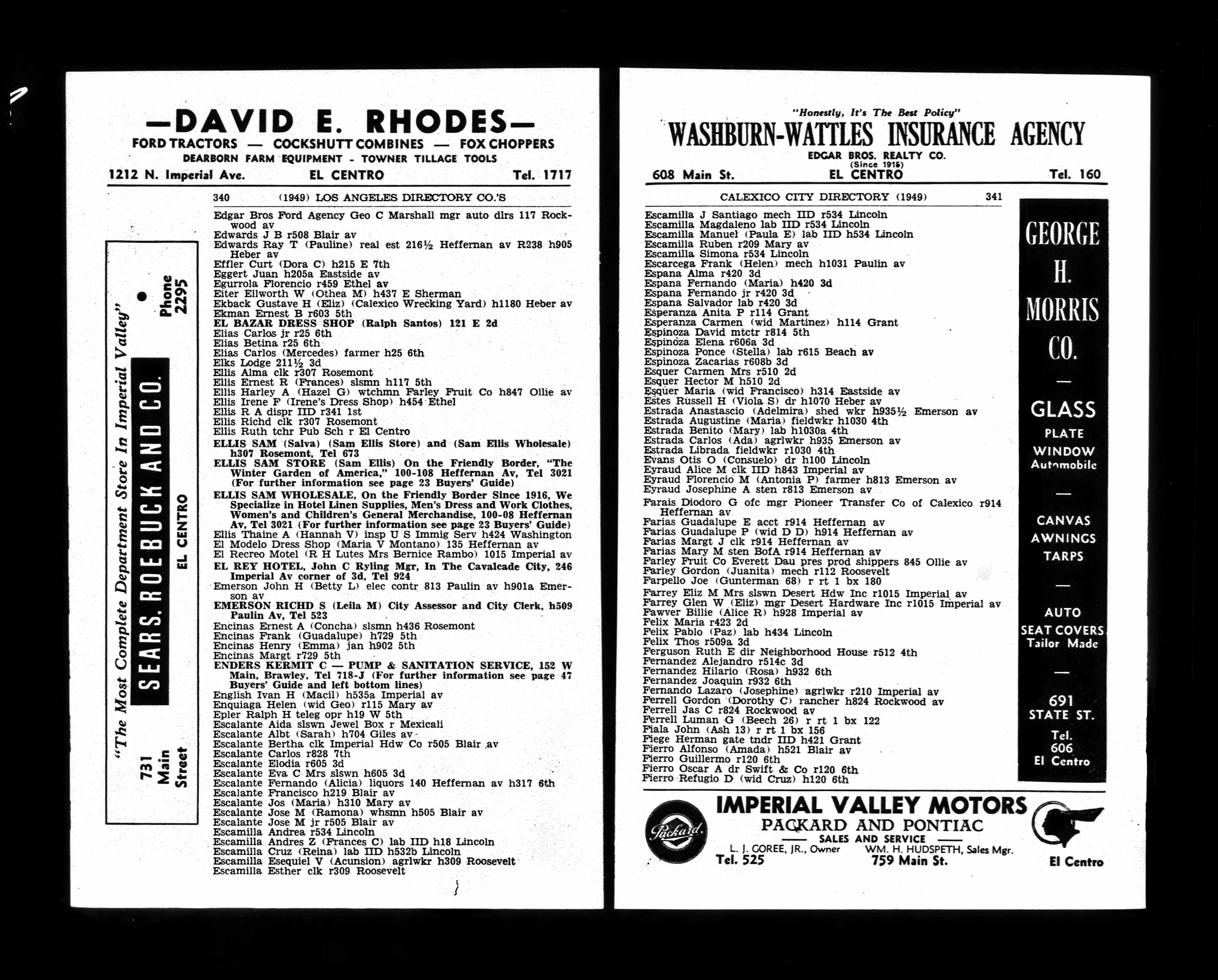
Uncle Charlie, Imperial County Directory, 1949.

Uncle Charlie, Imperial County Directory, 1949.

Uncle Charlie lived with Tia Panchita. He lived in the back room of their home. This was remembered by several nieces who went to live with her for periods of time. He was quiet and elusive, very much in the background of the Escalante family. Then, Uncle Charlie disappears too.

Carlos Escalante Jr.'s Wedding, 1957.

Carlos Escalante Jr.’s Wedding, 1957.

Carlitos was married in 1957. In the place of parental figures are Tia Panchita and Tio Alejandro.  (In the above photo from Left to Right – The Limon’s, his lovely wife, Carlos, Tia Panchita, and Tio Alejandro.) Tio Fernando and Tia Alicia are the Padrinos at the wedding.
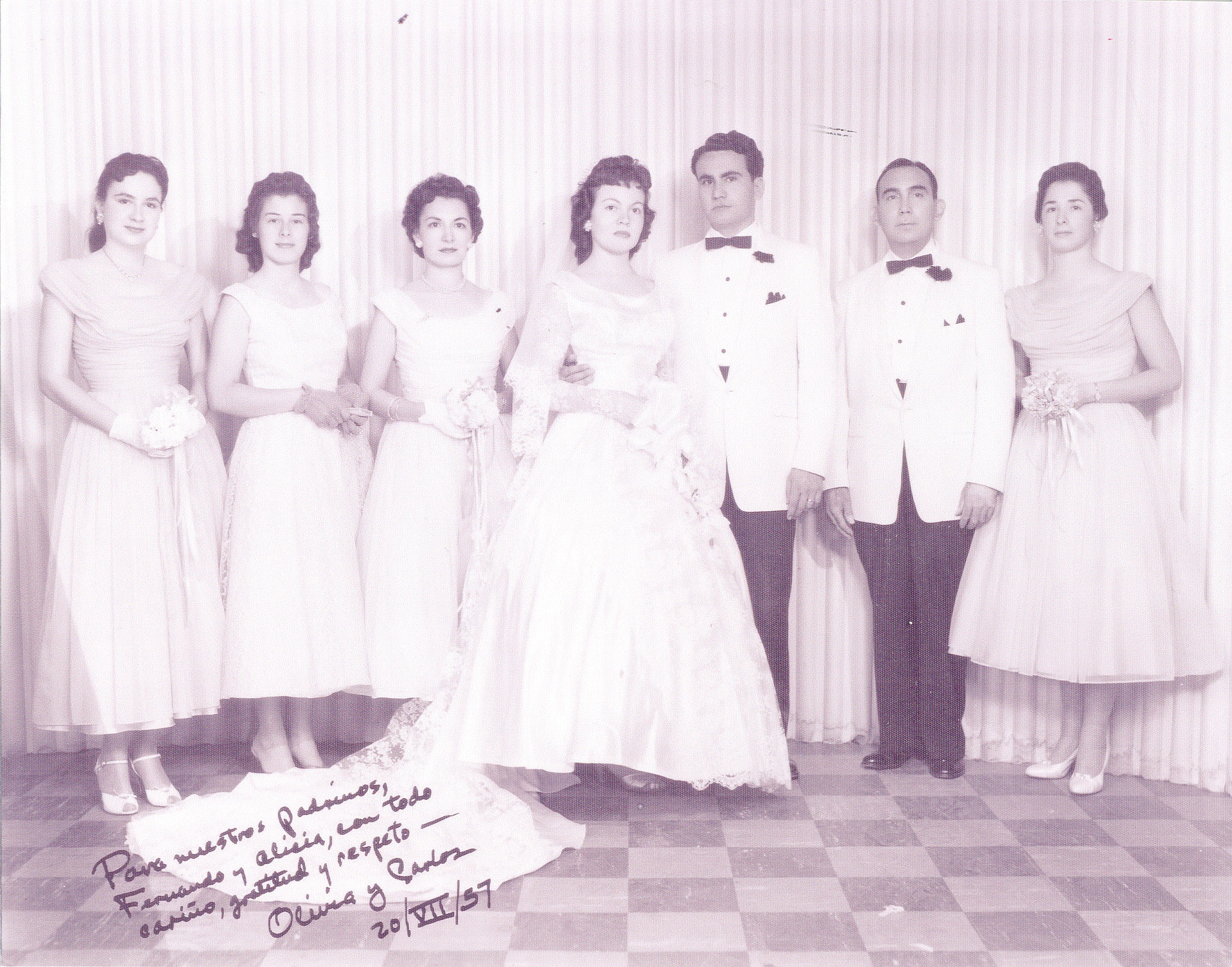
Carlos' Wedding Party, 1957. With his Padrinos, Tia Alicia (left of bride) and Tio Fernando (right of groom).

Carlos’ Wedding Party, 1957. With his Padrinos, Tia Alicia (left of bride) and Tio Fernando (right of groom).

Uncle Charlie is rumored to have died in Mexicali, so I have been unable to find any definitive dates. He is supposedly buried there in “Cemetario Dos.”

Uncle Charlie’s legacy was his one surviving son. Carlitos married his sweetheart. He had a good life with his family in the Bay Area. He passed away in 1989. He is survived by his wife and daughter.
Leonardo Escalante Jr.

Leonardo Escalante Jr was the second child. According to the documentation I can find, he was tall, with dark hair and eyes. He had three fingers on his left hand that were disabled. Fortunately, he was able to make a living on his skill as a barber.

He is the brother of which I know the least. He was born April 5, 1892, in Mexico. None of the paperwork I found have pinpointed which town, although Sonora is probably the state.

He worked as a barber in Santa Paula, and later in Orange County.

1919 must have been the year of great change. Before Maria’s twin children were born, it appeared that the Escalante’s were already going to Calexico and Mexicali for social events.  I may have mentioned that the Romo’s of Orange County got left behind. But that was okay, because there were quite a few Romo’s in Calexico as well! In fact, these Romo’s, cousins of David Romo Sr, open the social doors to several of the Escalante’s.

mexicalibaptism

The above article was from the Los Angeles Spanish newspaper, “Heraldo de Mexico.” It got quite the write-up. Leonardo was one of the “caballeros” at the baptism of Armando Marcelo Grisanti. His sister, Panchita (aka Frances), was one of the young ladies in the party. (Alejandro Garcia was also in the male listing. Panchita married him. Could this have been their first date?)

The party sounded amazing. Being the foodie I am, after finding family names, I read: exquisite mole poblano, chicken tamales, fresh beer and good wine. Wow!

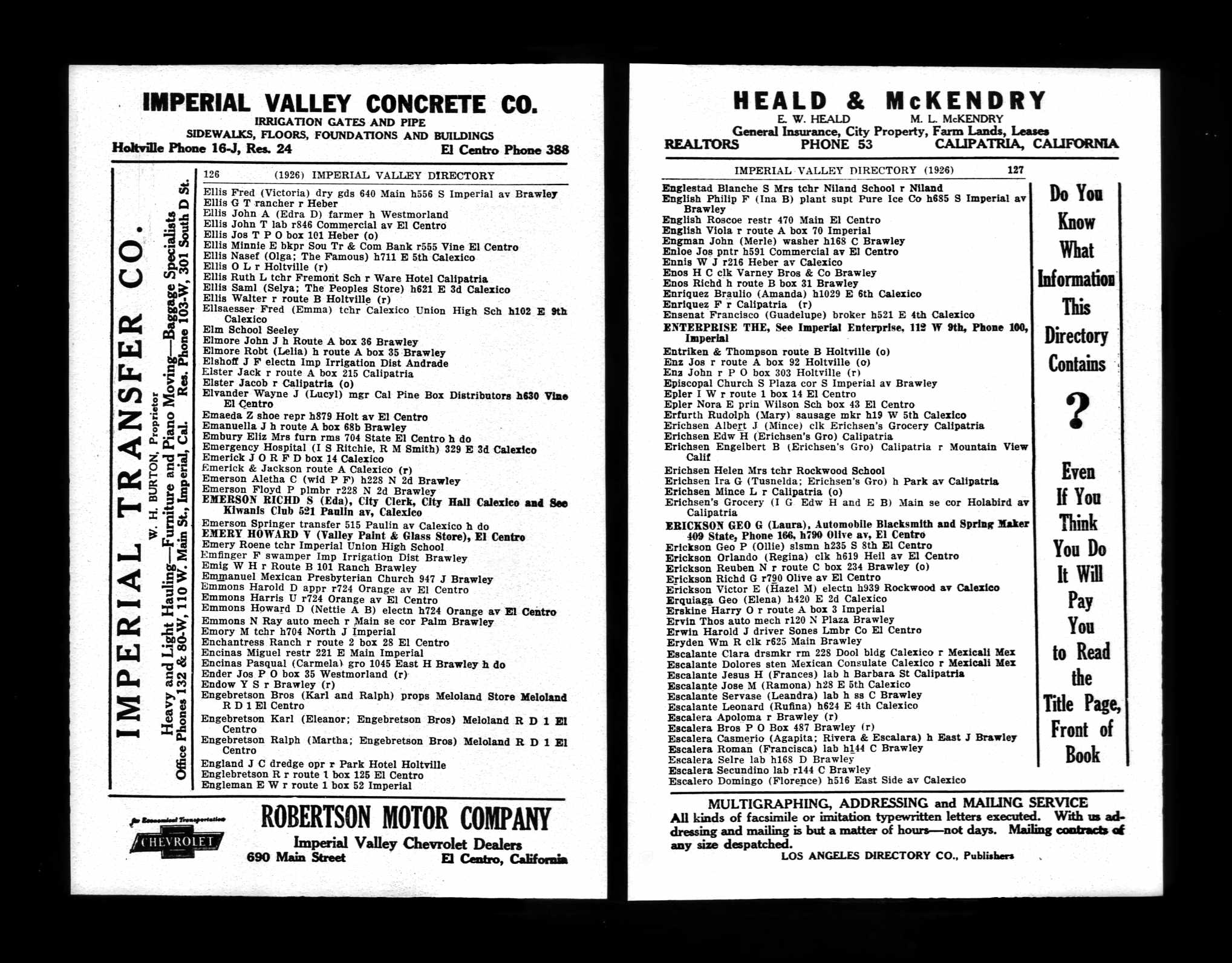
The only other thing I have found on Leonardo was a listing in the 1926 Imperial County Directory. The address was 624 E. 4th Street. The name Rufina is in parentheses. Was this because he took over the house (or boarding house) after his mom died in 1923?

Leonardo Escalante, 1926 Imperial County Directory.

Leonardo Escalante, 1926 Imperial County Directory.

And that is the last I can find of him. Anywhere. If he had lived, and died, in Calexico, there should have been an accessible death certificate on him. Maybe he went to be cared for in Mexicali, dying there…leaving me no paper trail.

You may have noticed his name was listed as Leonard here. When I interviewed my grandfather, he listed his siblings like this: “Joe, Leonard, Charlie, Mary, Ruben, Frances, Lupe, and Fernando.” My grandfather’s name became Albert, although he went by Tony. The Anglicizing of the names, on formal paperwork,  started early on.

Rumor had been that Leonardo died of the Spanish Influenza. But that period of turmoil was from 1918-1919. If he was still alive in 1926, maybe it was something else that took his life.  Even though he had no family of his own, he shared the name of his father, two nephews and one great-nephew. Not bad. Not bad at all.

Rufina Valenzuela de Escalante – 1868 – 1923

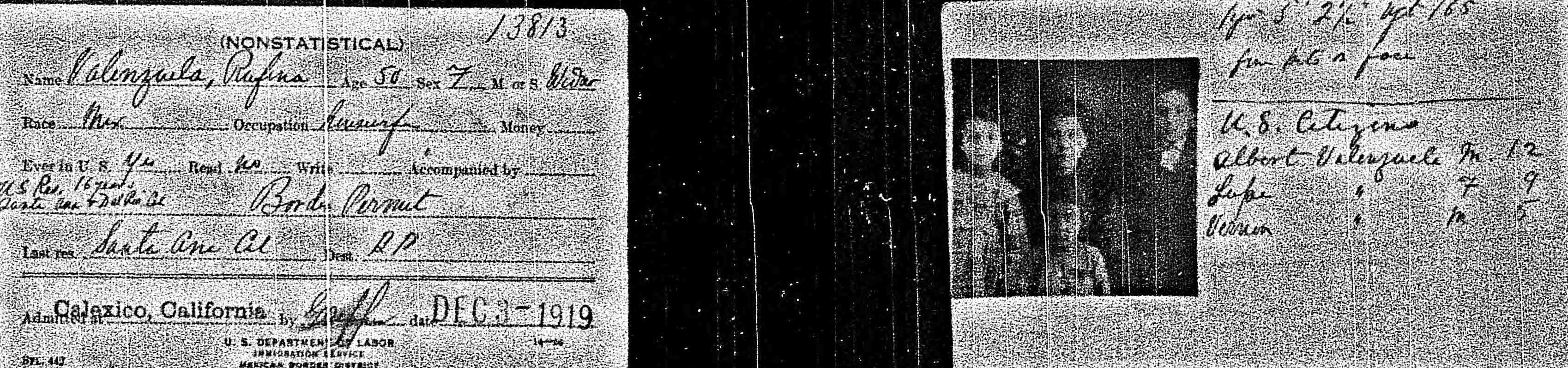
Rufina Escalante had been working to hold her family together during the last four and half years. Her sons had been helping to support her and their younger siblings. They were living in Orange County, near her sister-in-law’s family, as they had been for almost 20 years. And then, something changed. Now, while my tone sounds all ominous, I’ll be honest that I don’t know what “it” was. However, I do know that it happened after the family took a trip into Mexicali, via Calexico.

Rufina, and three youngest, visiting, Dec. 1919.

Rufina, and three youngest, visiting, Dec. 1919.

Thanks to the Border Patrol officer, this little card was difficult to find. Her married name, “Rufina Valenzuela de Escalante,” isn’t on this form. He probably only heard her say the first two names and that was all he wrote. And luckily  for us, they took her picture. She was with her three youngest children, Albert, Lupe and Fernando (although I think the officer heard Vernon).

What would take them back to Mexico? I found a manifest for her oldest daughter, Maria. Maria married Gabriel Morales. She had three children in 1919. Helen, 2 years old, and twins born in 1919, Leonardo and Maria Luisa. I’m pretty sure that would make me take a trip.

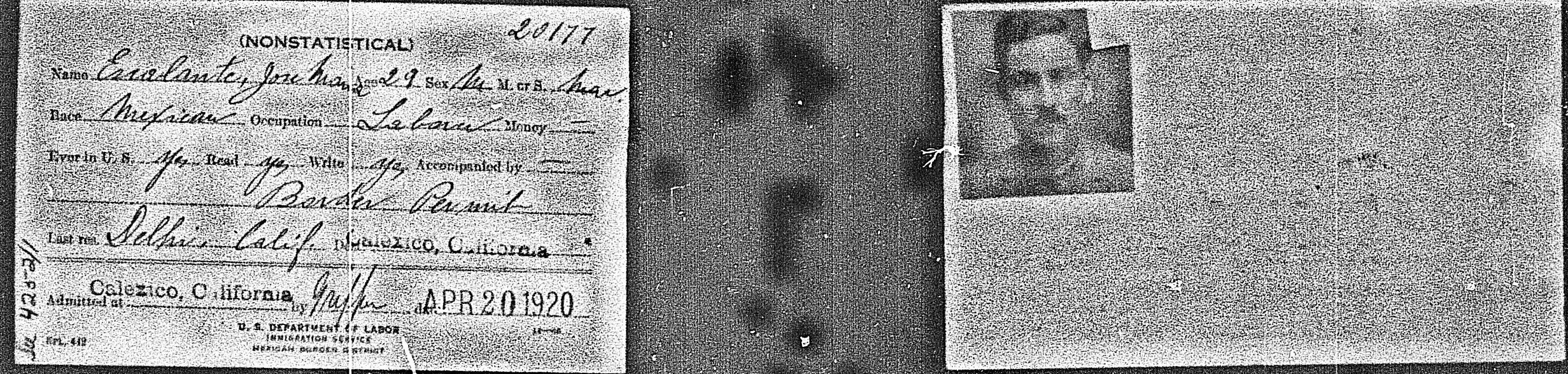
Jose Escalante visiting, 1920.

Jose Escalante visiting, 1920.

Jose wandered through in 1920. I verified it was him by his last residence, Delhi, CA. It seems that he’s still married (?). I can’t tell by the officer’s writing.

Charlie Escalante crossing, Dec. 1919.

Charlie Escalante crossing, Dec. 1919.

My mom remembers Carlos as “Uncle Charlie.” He seemed to be going by Charlie already at this point in his life.

Ruben Escalante visiting, Dec. 1919.

Ruben Escalante visiting, Dec. 1919.

And then there is Ruben.

Rufina had to make a very important decision. She had to decide between her husband’s extended family and her grandchildren. She had a sister living in Calexico at the time too. Guadalupe Valenzuela de Garcia had been a resident there for a while. Maybe the Escalante’s could connect to her side of the family for support now.

They moved.

Rumor has it that Rufina has a boarding house in Calexico while she lived there. I can’t find proof of that at all. Their move seems to coincide with the taking of the 1920 Census. I think they miss the documenting in both places. Grrrrr.

Her life in Calexico didn’t last very long. She started getting sick. She developed Bright’s Disease, which is a chronic kidney disease “involving inflammation and deterioration.”

Rufina Valenzuela de Escalante's Death Certificate.

Rufina Valenzuela de Escalante’s Death Certificate.

She died on Oct. 25, 1923. Her sister, Guadalupe, was the contact person for all of her personal information, such as their parents.

The Escalante children had their mother buried at the Mt. View Cemetery, Calexico, CA.

Rufina's tombstone, Mt.View Cemetery, Historical Section.

Rufina’s tombstone, Mt.View Cemetery, Historical Section.

The Escalante offspring were now adults and a few children alone in the world. They only had each other to rely on. The younger kids moved in with older siblings that could care for them. Most transitioned well. One did not.

My mom has often been told that she has her grandmothers’ eyes. My son has my moms’ eyes. It is of great importance for me to see this woman in a crystal clear photograph before I die. There is a $50 reward for anyone who could make that happen. Then I can post the picture. And we can all see the woman who held her family together for another 8 years after her husband died.

The Great War Comes to Orange County

The Great War that devastated Europe must have seemed so far away to those living in southern California. World War I lasted from 1914 until November 1918. Once the United States entered the war, it became necessary to find able-bodied men from all over the country. Every man had to register. And so they did.

June 5, 1917 was a very big day for the Escalante and Romo families of Orange County. Four out of six brothers showed up to fill out their paperwork. These papers were left to show us what everyone was doing, almost 2 years to the day after Leonardo Sr. dies.

Jose Escalante's WWI Draft Card, June 5, 1917.

Jose Escalante’s WWI Draft Card, June 5, 1917.

Above is the eldest Escalante son, Jose Maria, aged 31 years. He was living in New Delhi, CA. He was a laborer. He had dependents, a wife and child. Sadly, he did not name them. They also seemed to have disappeared in the next 5 years. Could it have been the Spanish Flu pandemic that killed them?

Leonardo Escalante Jr's WWI Draft Card. June 5, 1917.

Leonardo Escalante Jr’s WWI Draft Card. June 5, 1917.

Leonardo Jr. was 29 years old here. Hey! He was still a barber. He had dependents, his mother and siblings. They lived in New Delhi. He was described as tall, which wasn’t a typical Escalante male descriptor. Also, three of his fingers on his left hand were disabled.

David Romo Jr's WWI Draft Card, June 5, 1917.

David Romo Jr’s WWI Draft Card, June 5, 1917.

David Romo Jr’s differs from the Escalante boys in that he is living in Santa Ana, CA. He is working at Tustin Hill Citrus. Ahhh, the citrus trees of California….I digress. His listed dependents are his parents, wife (Carmela), and 2 children.

Manuel Romo's WWI Draft Card. June 5, 1917.

Manuel Romo’s WWI Draft Card. June 5, 1917.

Manuel Romo, Anna’s second son, also lives in Santa Ana. He stated that his dependents were his parents and brother and sister. He was working for a man named Sherman Emmett. These guys were not running toward getting married were they? Manuel and Leonardo were almost 30 and both single. No teenaged love affairs here.

So those were the four older brother that were the crux of their families. Eventually the two younger Escalante brothers showed up to fill out their forms.

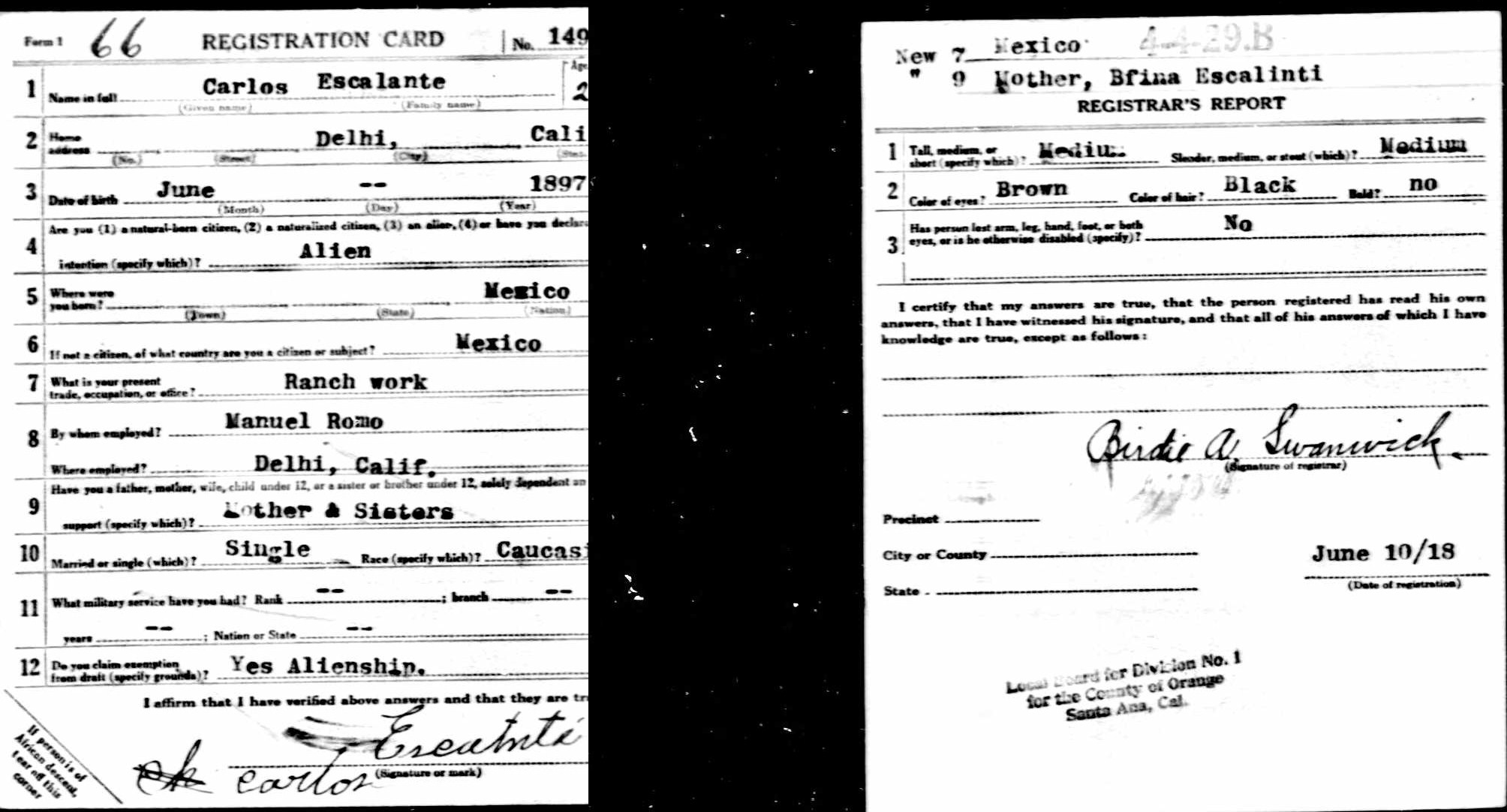
Carlos Escalante's WWI Draft Card, June 10, 1918.

Carlos Escalante’s WWI Draft Card, June 10, 1918.

Carlos’ draft card showed him living in Delhi. He was supporting his mother and sisters. He didn’t mention his little brothers. He was working for Manuel Romo. Now that’s interesting. Was Manuel now a supervisor? I love that the information taker, Birdie Swanwick, spelled Rufina’s name: Bfina Escalinti. Getting used to that new typewriter, Birdie??

Ruben Escalante's WWI Draft Card, Sept. 12, 1918.

Ruben Escalante’s WWI Draft Card, Sept. 12, 1918.

And last, but not least, Ruben Escalante got to register. He was living in Gloryetta, CA. Gloryetta, from what I can tell, was also a small town in the same vicinity as Delhi. They even had their own post office at one time. If not for forms like this, one might not even remember these little towns existed under the sprawling cities that are currently there. Ruben worked for Sherman Emmett too. He lived with his mother.

These forms really give a quick, but full snapshot of what the family was doing at the time. The men were working to care for their families. The Escalante men were taking care of their mother who still had little ones to raise. The 24-year span of childbearing could make life difficult for a woman who was a widow. But her sons stepped up to the plate to assist her.

Now, having been with the Romo’s so long, it would seem that the families would stay together forever.  In 1919, the Escalante’s went to visit someone in Mexico. Rufina returned via Calexico. My guess was that everyone went to see grandchildren from her daughter Maria. She also had a sister in Calexico, Guadalupe Valenzuela de Garcia. Was it a family meeting that decided they should all move for better opportunities? Whatever the reasons, the Escalante’s decided to leave their extended family of 20 years. They moved to Calexico, California. A move which changed the Escalante family. Forever.

Leonardo Escalante: 1866-1915

On June 16, 1915, Leonardo dies.

The cause of death was “Phthisis Pulmonalis Organic.” It is the antiquated way of saying “consumption of lungs, strictly applied to tubercular variety.” He died before he turned 50.

Leonardo Escalante Sr's Death Certificate.

Leonardo Escalante Sr’s Death Certificate.

When I talked to the lady at the Santa Ana Cemetery, she said, “Oh. He died in Delhi.” Apparently, I was supposed to know what that meant. There is a Delhi, CA, but it is in the San Joaquin Valley. I thought it was strange that the family would move up north and then bury him a few hundred miles away. I was also shy about not asking more questions at this point in my research too. It took about another 10 years for me to discover that Delhi (aka New Delhi) was an “old school” name for an area where Tustin now is.

Rufina may have been consulted to provide information on his certificate. “Pool Room” was still listed as his occupation, but I have been unable to find that he was working this job in Orange County. This kind of “career highlight” isn’t unusual though. My grandfather’s occupation was listed as the owner of “Tony’s Round-Up” on his death certificate, but he hadn’t worked the restaurant for over 20 years.

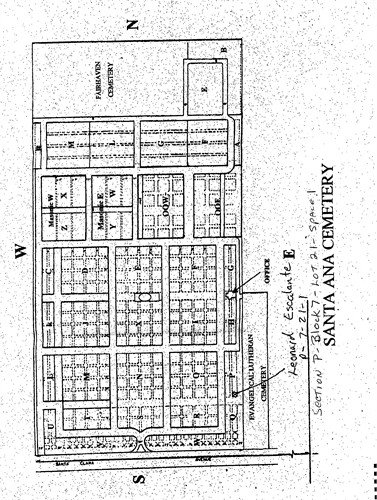
I have been back to see Leonardo several times. He was buried in the Santa Ana Cemetery. There were Romos buried there too, in a different section. Here are the documents I received from the cemetery.

Location of Leonardo's grave at Santa Ana Cemetery.

Location of Leonardo’s grave at Santa Ana Cemetery.

This form lists all of the information the office still holds regarding the grave.

This form lists all of the information the office still holds regarding the grave.

Leonardo's gravesite with tombstone from Anna.

Leonardo’s gravesite with tombstone from Anna.

While it is difficult to read, the bottom line on the tombstone says something about his sister. I took a rubbing from it last time I was there, but have misplaced it. I am almost positive Anna was the one who bought the grave marker for her little brother. He was the one who had been with her growing up and had been her friend their adult lives. He was a reminder of both of her parents and the life they had before their father died.

Rufina, his wife of almost 30 years, was now a widow with only one out of the house being married. Her eldest boys would undoubtedly help, but the youngest children were 11, 8, 6 and 1.

The paths of both families will change. Without Leonardo’s link to his sister, Rufina will make several decisions that will sever the close ties that have bonded the families for almost two decades.

What Makes You Say That?

The Escalantes and the Romos left Ventura County after almost 15 years. They left behind friends and their businesses. They decided to move down toward the growing metropolis of El Pueblo de al Reina de Los Angeles. (Ha ha! I’ve always wanted to use it’s full Spanish name).

The opportunities at the beginning of the 1910’s must have been amazing in California for families that had hard-working members in them. These two families ended up Santa Ana by 1915. However, they did make a stop in Los Angeles for a while. “What makes you say that?” you may ask. Hard as I have tried to find more out about this tiny side stop, I have only one piece of documentation to prove it.

Fernando's Birth Certificate, Los Angeles, CA, 1914.

Fernando’s Birth Certificate, Los Angeles, CA, 1914.

The baby of the family, Fernando Escalante, was born on May 31, 1914 in Los Angeles. He came into the world at 12:30 pm. He was delivered by a medical student named S. Rosenkranz. The certificate shows us a few other things as well. He was born in the house where the family was living. They were residing at 3335 Emmett, Los Angeles. I wanted to show where this location was, but it is very difficult to find a map from 1914 that is easy to read.

One other interesting fact that was found on the form was Rufina had her share of losses when it came to childbirth as well. While she did not lose near as many babies as her sister-in-law, Anna, she had lost three. This form tells us that Rufina had 12 babies, 9 now living. Rufina had Fernando, her last baby, at age 43. Leonardo was 48.

This was the only stop I found for the two families in the Los Angeles area. There must have been family or friends in the vicinity. They moved on one more time as a collective group. Rufina and Anna became the first “Housewives of Orange County” after they move to the present Santa Ana. It wasn’t going to last long though.

By June 1915, the lives of the Escalante family changed forever.

David Romo, Jr. Finds a Wife

I thought this little story was cute. I would be very surprised if the Romos had wanted the story in the newspaper. It was in the “Oxnard Courier” on August 19, 1910, after having run in the “Los Angeles Times.” The article is under “Former Camarillo Man….”

David Jr wants to marry Carmela

It appears as if good match for the Romo sons could not be found in California. David Sr. contacted his sister. (And darn it if no one mentions her name!!) She came from Mexico and brought her two lovely daughters along. David Jr. fell for the youngest daughter, Carmela Martinez. Because she was only 17 years old, she was too young to get married. Her father, Ramon Martinez, came from Ures, Sonora, to argue his daughter should go back home until she was old enough.

Maybe David Jr. was too ardent a lover. Officials decided to put Carmela with the jailer’s wife to keep her safe until her fate could be decided.

I did find the end to this episode. Below there are two manifests.

Carmela Martinez de Romo arrives Oct 12, 1910.

Carmela Martinez de Romo arrives Oct 12, 1910.

David Romo brings her home.

David Romo brings her home.

The gentleman brought his lady home. Yea!! These forms stated they were going back to Santa Paula. Now that Carmela was in the family fold, the families could move on to a different life in Los Angeles, and then Orange County, CA.

Anna Escalante de Romo – Part II – Ventura County

What exactly brought the Romo family out from Ures or Hermosillo may never be known. When a person takes into consideration the mild climate of Ventura County  however, it was probably a no-brainer. And then there is California and the American Dream.

According to the 1900 US Census, the Romos get to Hueneme Township between 1892 and 1894. They have been married for over 20 years already. Anna has had 9 children. They currently have only three living sons: David Jr, Manuel and Amado. Amado dies in 1908. I cannot even imagine that kind of pain and heartache. David Sr. is working as a farm worker, like his brother-in-law, Leonardo.

Ten years later, the Romos are doing very well. Anna has had two more children, Mercedes and Rodolfo. Rodolfo is only a year older than my grandfather. I guess that they are good friends growing up like their big brothers.  My grandfather names his 5th son Rudolph.

In the 1908 Santa Paula Directory, David Sr has Pool Room as his occupation. Leonardo is still listed as Laborer. By the 1910 Census, both men are in business for themselves. While Leonardo is working a Pool Hall at 309 E. Main in Santa Paula, the Romos are down at 100 E. Main with a similar set up. David Sr. is selling cigars, tobacco and soft drinks. Manuel is a barber in the same building.

The Romo business at 100 E. Main Street, Santa Paula, CA 1910.

The Romo business at 100 E. Main Street, Santa Paula, CA 1910.

I tell you these families were close. They were working the same businesses at the same time! Quite amazing.

I have a feeling that Anna and Leonardo came from what would have been considered a “good family” in Hermosillo. Their sister, Maria Ramirez, married into the Barbachano family. Her husband was the son of a state governor. No small feat. The reason I mention the tacky issue of status and/or money, is because Anna seemed to have some.

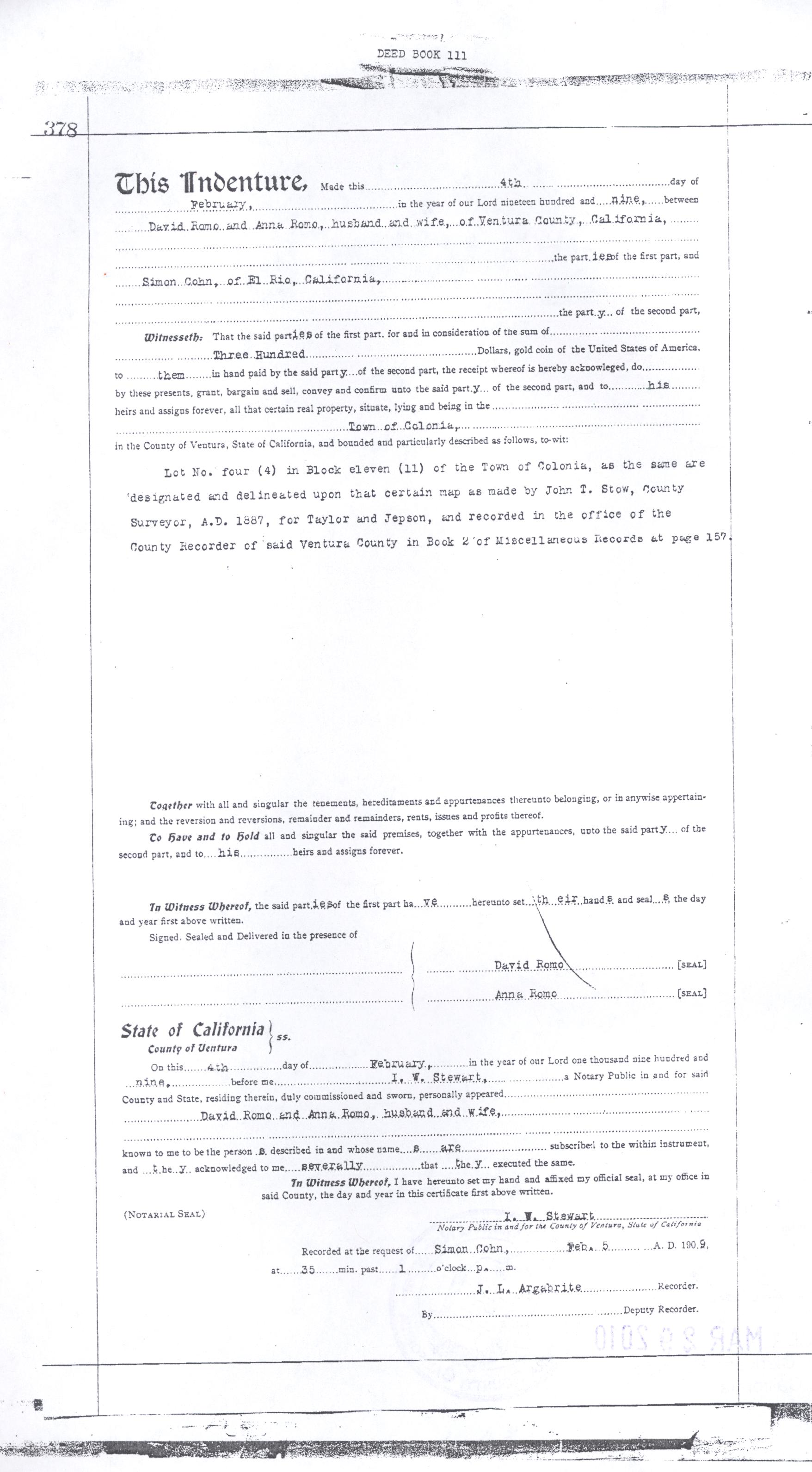
From the years 1902-1909, she purchases or sells 8 pieces of land to the likes of Simon Cohn, Gabriel Gisler, and HL Wineman. The grand total of monies traded was $670. That is no measley amount of pocket change.

Last land transaction. Anna and David sell to Simon Cohn, land in Colonia for $300.

Last land transaction. Anna and David sell to Simon Cohn, land in Colonia for $300.

While David is a part of the purchasing occasionally, Anna is unique in purchasing several pieces in her name alone. Quite saucy for the times, I would imagine.

With Anna’s last large sale, I wonder if the families were starting to think of moving on to Orange County. They disappear from Ventura County right after 1910. There is one more tale that is posted in the “Oxnard Courier.” The story, however, belongs to David Romo, Jr.  I will give him the credit before we take the family down south.

Anna Escalante de Romo – Part I – Getting Married

I have found out more about Leonardo simply by finding his sisters. From his showing up in 1898 in Ventura County until his death in 1915, these two families were practically one Family. I see Leonardo and Anna loved each other. She is the one who purchased his tombstone, or at least had it enscribed. They had been through much together. They planned, trained and worked together. Finding Anna helped me see where Leonardo came from.

While ancestry.com is one of my big gun tools, every once in a while I wander over to the free LDS website, familysearch.org. It has been a great resource with documents from Mexico. This proves to be a tiny bit difficult for me to use as I cannot read or speak Spanish. Dora the Explorer is about my limit, but I use a web-based Spanish/English dictionary on special occasions.

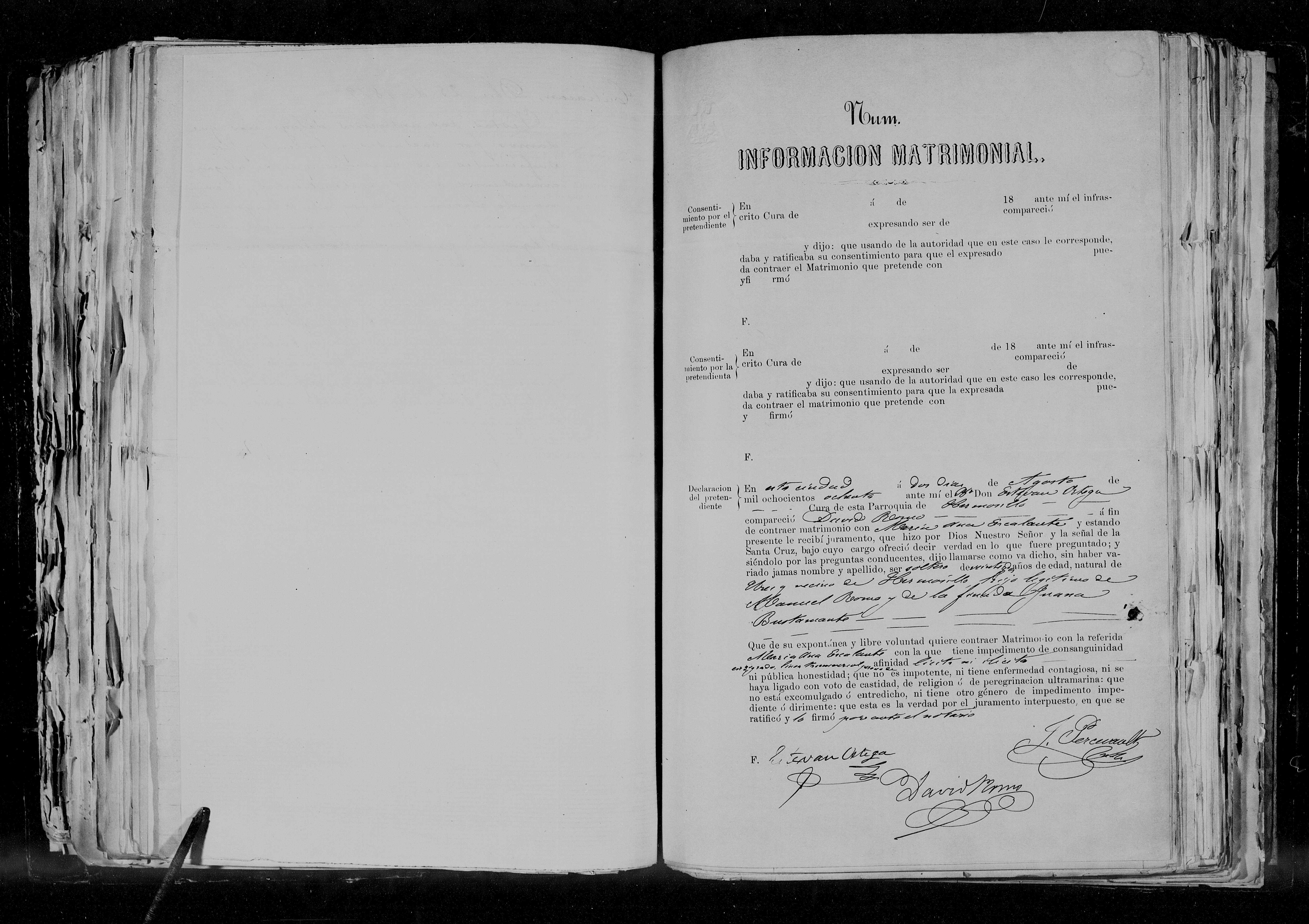
During the last 6 months I found the wedding documentation between Maria Ana Escalante and David Romo. (Her mother was Mariana, so I believe Anna was used to differentiate them around the home.) These particular pages filled in so many blanks, it boggles the mind.

David's Background before wedding at La Catedral in Hermosillo.

David’s Background before wedding at La Catedral in Hermosillo.

In August of 1880, these two are petitioning to get married. He is from Ures, Sonora. His father is Manuel Romo and his mother is Juana Bustamante. I love his young signature at the bottom of the page.

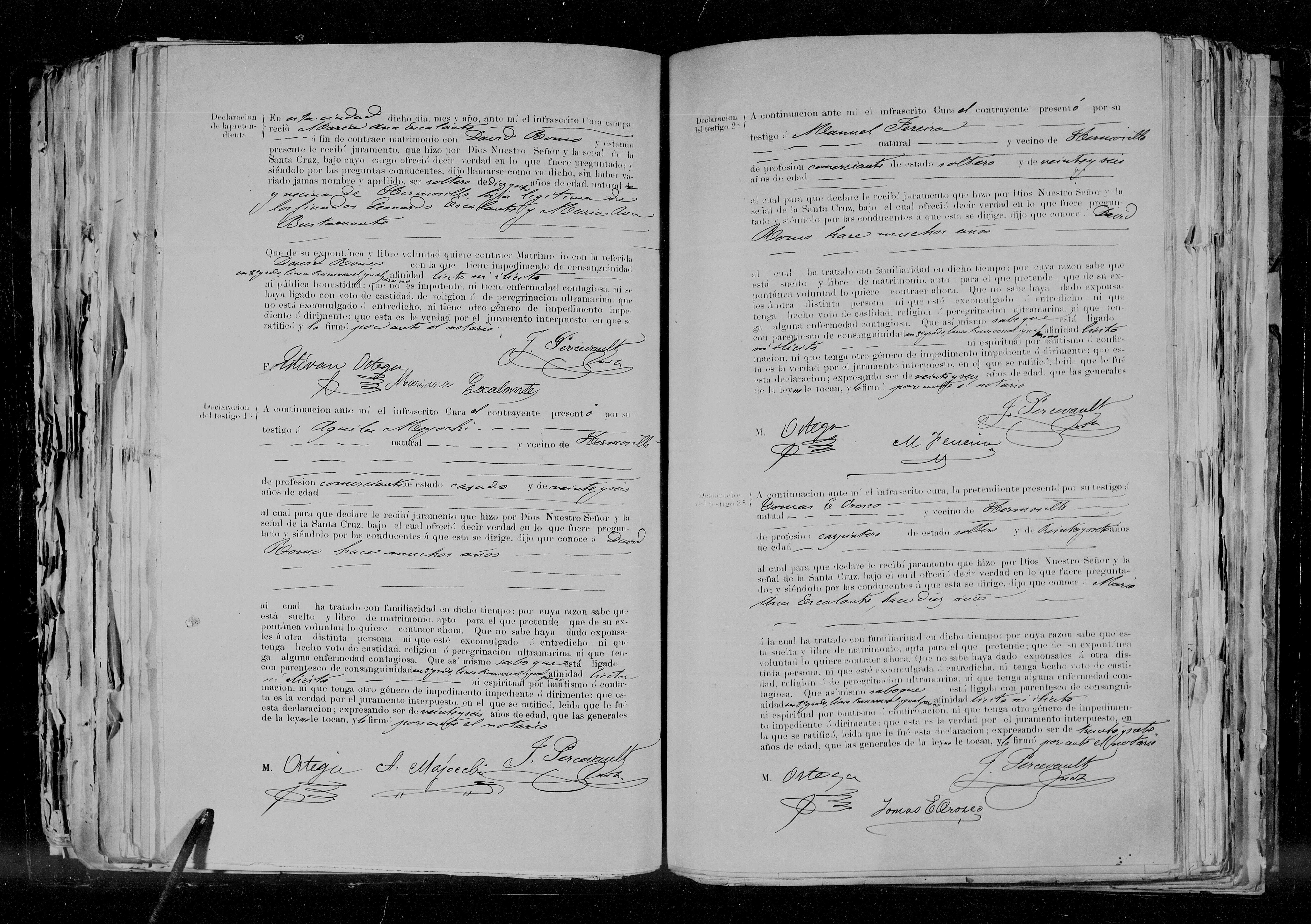
Anna's wedding information, along with witnesses.

Anna’s wedding information, along with witnesses.

In the upper-left corner, you will see Anna’s information. She’s a legitimate child (whew) from Hermosillo born to Leonardo Escalante and Mariana Bustamante. The other three sections are either witnesses or padrinos. (I would love some help from some Spanish translators.)

And my little heart is beating all fast as I’m pretending to read these sheets. I am aware of enough of the language, and previous research, that these are the right people. Then I turn the page….

A gift of more family tree, because they are distantly related!

A gift of more family tree, because they are distantly related!

I’m cruising down the page, imagining all of the families together at the joyous occasion. (Have I mentioned I was a history minor? This stuff is just too cool.) Anyway, at the end of the left page there is a lot of “written in” stuff. And what I do recognize is the term “Arbol genealogico,” or “Family Tree.” My brain processes…what?? Oh, yeah! The mom’s have the same last name.

So in order for the Chruch to allow this marriage, there has to be an acceptable amount of generations to have passed for these distant cousins to marry. We get to find out more about Mariana Bustamante’s family.

Juan de D. Bustamante had two sons: Marcial and Antonio. Each one had two daughters: Juana and Mariana. Each of those had: David and Anna. The church gave it’s blessing. As a researcher, I am so grateful they had this little “dilemma.” It allowed me to go back another two generations on the Bustamante side.

So when I ponder why Leonardo loved the whole Romo clan, it’s no wonder. They truly were Family. With a great big Capital “F.”

Anna and David fly under the radar for the next 14 years. They pop up again in Ventura County in 1894.

Leonardo Escalante in Ventura County 1898-1910

Leonardo Escalante….I didn’t know much about him when I started this journey. What I’ve heard from my grandfather, Albert, is that he remembers travelling on a wagon to get supplies with his dad. He was little, but it must have been a wonderful memory. And that is the only memory I’ve really heard. But what about his background? Where did Leonardo settle down? His avoidance of being in any census made me wary of his profession once I found it. What exactly would I find?

Luckily for me, when I was looking for his sister, Anna Romo, in the 1900 Census, my brain turned on. I decided to browse around and see who Anna’s neighbors were. And then, the blinders came off. Her next door neighbors in 1900 were none other than “Leonardo Scanlant” and his family. Ah ha! Awesome! And boy…. that really IS being close to your sister.

Leonardo living next door to his sister's family in Hueneme Township 1900. Courtesy of ancestry.com.

Leonardo living next door to his sister’s family in Hueneme Township 1900. Courtesy of ancestry.com.

So much information in one place! And kindly enough, a list of the children in birth order. Lovely. They appear to have come to the United States in 1898. The census tells us that Leonardo is a Farm Laborer, along with David Romo, at this time. It would be interesting to know whom he worked for. They seem to know The Gonzalez family well, as they were godparents to several of the children. The Gonzalez’ were California born. They worked as laborers who eventually end up with their own ranch. Eduardo Gonzalez is a Horse Trainer the last time he is on a census.

**Fascinating female trivia: The cenus asked quite personal questions. How many children have you had? How many are still alive? Anna had 9 babies, but only 3 living. Amado, the baby, dies before they leave Ventura County. Rufina had 6 babies, with 5 still living. Rumor had it that Maria was a twin. Maybe that was the baby who died. Sister-in-law tensions could have been high where one woman was more successful in her childbearing than the other.**

It seems that everyone is working differently in a meager 10 years. The 1910 Census finds Leonardo’s family in Santa Paula, CA. He is a few doors down from the Romo family. Leonardo is no longer working on the farm. He owns a pool hall.

1910UnitedStatesFederalCensusForLeonardoEscardarite

In the last decade, three more babies came into the picture. Jose, the eldest son, has left the home. Leonardo Sr is the owner of a Pool Room. His son, Leonardo Jr, owns his own Barber Shop. On the form you will see “OA” next to their names. This indicates they are “working on their own account.” This is amazing news. David Romo is the manager of a Pool Room. Can you get an idea of who he works for? And David Jr is a barber in his own right as well.

City directories are becoming popular. And now my great-grandfather is no longer shy about being found.

Leonardo Sr and Jr at their respective businesses in Santa Paula, CA 1910.

Leonardo Sr and Jr at their respective businesses in Santa Paula, CA 1910.

Interesting factoid: The Pool Room and Barber Shop took up the same space. (Calling the health inspector!).

One of the last things I found on Leonardo in Ventura County was a bill of sale between Leonardo with Rufina and Simon Cohn. Cohn purchased a lot in Colonia from the two in September, 1910, for $10 in gold coin. They had been property owners as well. Hard work paying off? Inheritance money from his parents? (More on this theory when I discuss Anna Romo in Ventura County. She bought quite a bit of property with quite a bit of gold.)

Leonardo and Rufina selling land to Simon Cohn, Colonia, CA.

Leonardo and Rufina selling land to Simon Cohn, Colonia, CA.

Then, they leave.

What happens to make both families, with successful business opportunities, leave their homes of over 10 years? I have no idea. I’ve read that Santa Paula was going through a Mexican backlash by the 1920s. It must have been something quite profound to get them out of their social group to move down the coast.

The youngest child, Fernando, was born in Los Angeles in 1914. Leonardo died in New Delhi, Orange County, CA (now Santa Ana/Tustin area) in 1915 of tuberculosis. Rufina and her 9 children were near the Romos for approximately 4 more years. And then the the story changed. Again.